
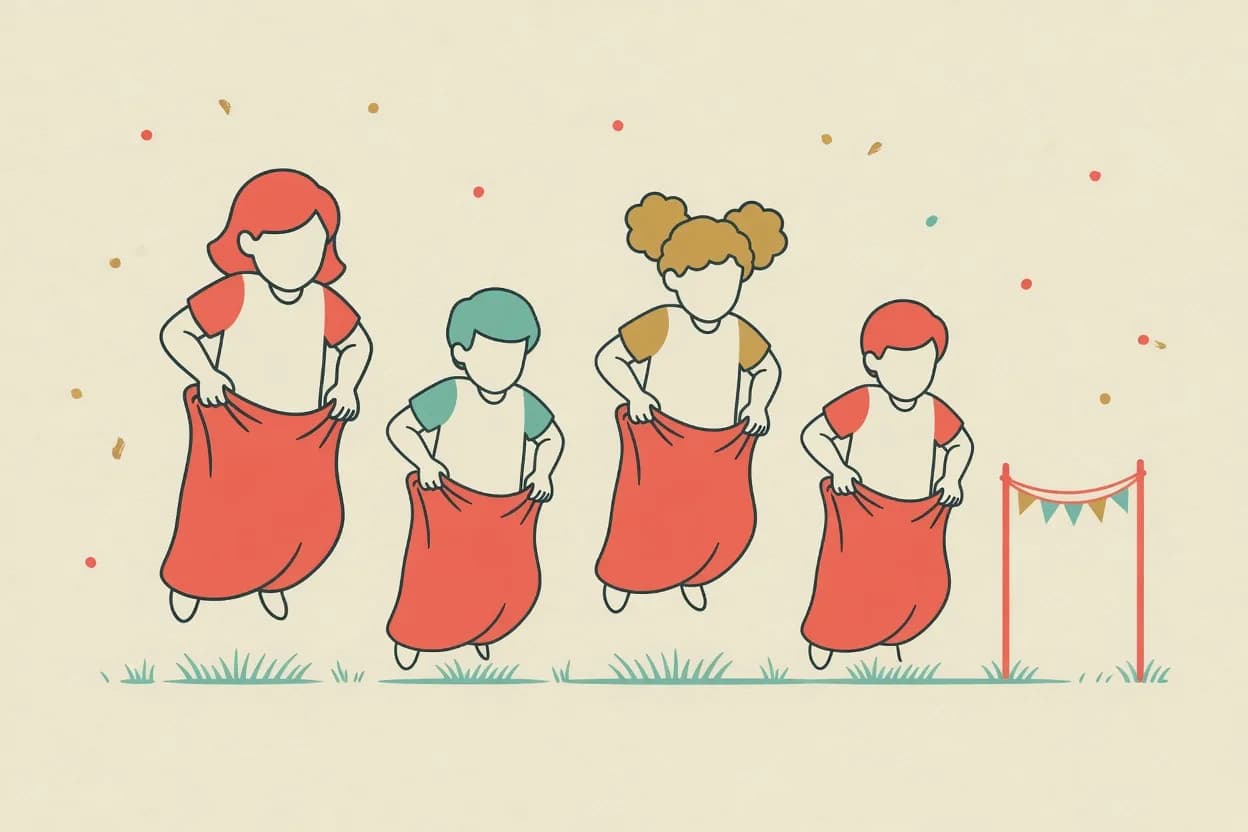
The sack race is the most reliable five minutes of joy at any outdoor party. It costs almost nothing, it needs no explaining, and the sight of six children hopping sideways into each other is funny to absolutely everyone present, including the children. It also rewards a little bit of technique — which means you can teach a losing child something useful between heats and watch them win the next one.
What you need for a sack race
- Sacks that fit. Burlap sacks are traditional but scratchy on bare legs; heavy-duty pillowcases work beautifully for younger children, and large reusable shopping bags with the handles cut off are a good budget option. The top of the sack should reach roughly the racer's waist. Too long and they cannot jump; too short and they cannot hold it.
- Flat grass. Everyone falls in a sack race. Grass is the difference between a fall being the best part of the day and the end of the party.
- A short course. Fifteen to twenty paces is plenty. A long course just produces a slow procession of tired children.
- Clear lanes. Mark start and finish with cones, ribbon or chalk, and leave a good arm's width between racers so a wobble does not become a pile-up.
Sack race rules
- Each racer steps into a sack and holds the top edge with both hands at hip height.
- On "go", racers jump — both feet together — from the start line to the finish line.
- Both feet must stay inside the sack the whole way. Running with the sack around one ankle is the classic disqualification, and children will absolutely try it.
- If a racer falls, they get back up where they fell and keep going. Falling is not a disqualification and should never be treated as one.
- First across the line wins. Run heats if you have more than six racers, then a final.
How to win a sack race: technique
Almost every child's instinct is to take one enormous leap, land badly and fall over. The winning technique is the opposite of that.
Small, fast jumps beat big ones
Short hops keep your weight over your feet, so you stay balanced and never stop moving. Big leaps send your body forward ahead of your feet — which is exactly how you end up face down at the halfway line, watching someone half your size hop past. Think quick and low, like a jump rope rhythm rather than a long jump.
Hold the sack high and wide
Grip the top edge with both hands, knuckles out, and pull it up towards your waist rather than letting it sag around your knees. A sack held high gives your feet room to lift; a sagging sack traps them. Pulling the sides slightly apart as you jump helps too.
Land on the balls of your feet, and keep your eyes up
Landing flat-footed kills all your momentum and jars the knees; landing softly on the balls of the feet lets each landing feed straight into the next jump. And like every race, you go where you look — eyes on the finish line, not on the sack.
Start moving on the word, not after it
In a race this short, the start is worth more than anything else. Stand with knees already bent, sack already gripped and tension already in the legs, so the first hop happens on "go" rather than a second later.

Sack race variations
- Sack relay. Teams of four, one sack per team, race to the cone and back and hand the sack over. Instantly turns a ten-second race into a real team event with something to cheer.
- There-and-back. Around a cone and home again. The turn is where races are won and lost, and it doubles the length without doubling the course.
- Obstacle sack race. Two or three cones to weave around. Better for older children, who otherwise find a straight sprint too easy.
- Parent and child pairs. One large sack, one adult and one child inside it together. Slow, undignified, and the single most photographed event at any party.
- The egg-and-sack. A sack race holding a spoon, for the truly ambitious. See our egg and spoon race guide for how to keep that from ending in tears.
What age is a sack race good for?
From about four, with a caveat. Three- and four-year-olds cannot reliably jump with both feet together, so let them shuffle, walk or waddle inside the sack and call it a race — the fun is in the sack, not the technique. From five to six the two-footed jump clicks into place and it becomes a genuine contest. From seven upwards, add relays, turns and obstacles, because a straight fifteen-pace hop stops being a challenge.
Sack race safety
- Grass only, and walk the course first to clear stones, sprinkler heads, dog droppings and molehills.
- Check sacks for splits and stiff seams, and make sure none is long enough to trip over.
- Sneakers on, hoods down, no drawstrings, and nothing in anyone's hands or mouth.
- Keep spectators well behind the finish line — racers cannot stop quickly and cannot see much.
- Run small heats rather than one big scrum, and leave a clear lane per racer.
Sack races pair perfectly with the other classic lawn games — try running them alongside a three-legged race and a tug of war as a mini field day, or browse local entertainers if you would rather someone else brought the sacks.
Frequently asked questions
- What can you use instead of burlap sacks for a sack race?
- Heavy-duty pillowcases work beautifully for younger children, and large reusable shopping bags with the handles cut off are a good budget option. Whatever you use, the top should reach roughly the racer's waist — too long and they can't jump, too short and they can't hold it.
- How long should a sack race course be?
- Fifteen to twenty paces on flat grass is plenty. A longer course just produces a slow procession of tired children — if older kids need more of a challenge, add a turn around a cone or a few cones to weave through instead.
- What's the fastest way to jump in a sack race?
- Small, quick hops rather than big leaps. Hold the top of the sack high at your waist, land softly on the balls of your feet, keep your eyes on the finish line, and be ready before the start so your first hop happens right on "go."
- Is it a disqualification to fall in a sack race?
- No. A racer who falls gets up where they fell and keeps going. The classic disqualification is running with the sack around one ankle — both feet have to stay inside the sack the whole way.
Perfect for these parties
Themes that build a whole party around this game — with the food, the decor and a printable invite to match.