
The egg and spoon race is the thinking child's party game. It is the only race at a field day where going faster makes you worse, which is a genuinely useful lesson delivered in about thirty seconds, and it gives the least athletic guest at the party a real chance of winning something. It is also, if you use actual raw eggs, a decision you will be scrubbing off the patio later — so this guide covers both the traditional version and the swaps that keep it clean.
What you need
- Spoons. Soup spoons are the sweet spot — teaspoons are cruel and serving spoons are too easy. One per racer, all the same size, or the losers will rightly complain.
- Something egg-shaped. Hard-boiled and cooled eggs are the classic and by far the best choice: they behave like real eggs but survive being dropped. See below for the no-mess options.
- A short, flat course. Fifteen to twenty paces. This race is already slow; a long course makes it dull.
- Spare eggs. Always. Something will roll into a flower bed and never be seen again.
Egg and spoon race rules
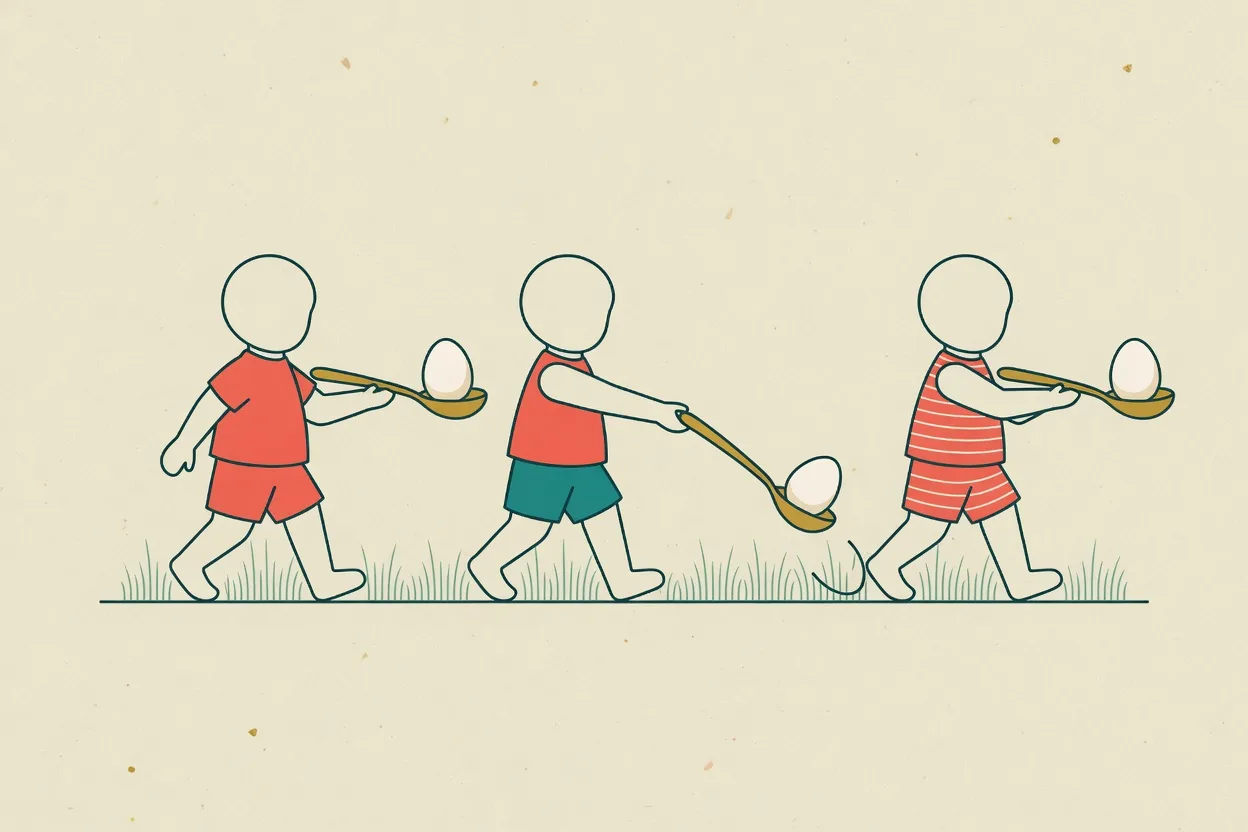
- Each racer holds their spoon in one hand, with the egg sitting on it, and lines up behind the start.
- Only one hand touches the spoon. The other hand stays down — no cupping, no steadying, no thumb over the egg.
- On "go", racers walk or run to the finish line without dropping the egg.
- If the egg falls, the racer stops, picks it up, replaces it on the spoon where it fell, and carries on. That penalty of a few lost seconds is what makes recklessness expensive.
- First over the line with the egg on the spoon wins.
The thumb rule is the one to state clearly before the start and enforce gently during, because every single child will try it. A referee walking alongside the pack catches it without anyone feeling picked on.
How to win an egg and spoon race
Hold the spoon at the very end of the handle
Counter-intuitive but true: gripping right down at the tip of the handle gives your wrist more room to make small corrections, and lets the spoon float rather than transmitting every bump from your shoulder. Choking up close to the bowl makes the spoon an extension of your arm, and your arm bounces when you run.
Arm out, elbow soft
Hold the spoon out in front of you at about chest height with a bent, relaxed elbow acting as a shock absorber. Locked-out straight arms transfer every footfall straight into the egg. Keep the spoon level — tilt is what starts a roll, and once an egg starts rolling it never stops.
Watch the egg, not the finish line
This is the reverse of every other race, and it is the winning habit. The egg tells you a fraction of a second before it goes, which is exactly enough time to correct. Glance up occasionally to check you are going straight, and spend the rest of the race looking at the spoon.
Walk fast, don't run
A smooth, quick walk with small steps beats a sprint over this distance, because sprinting bounces the egg off the spoon within about four strides. Glide — keep your head at a constant height and your feet under you. The child who walks briskly and never drops the egg beats the child who sprints and drops it twice, every time.
No-mess alternatives to real eggs
Raw eggs are traditional, dramatic and a genuinely bad idea at a party: they are a slip hazard on a hard surface, an allergy consideration, and a waste of food. Any of these behave well and clean up in seconds:
- Hard-boiled eggs. Boil them the day before and cool them fully. Closest to the real thing, and no mess when one hits the ground.
- Plastic Easter eggs. Cheap and reusable, but very light and prone to blowing around. Put a coin or a few dried beans inside to weight them.
- Small potatoes or lemons. The house favorite. Perfectly egg-shaped, nicely weighted, entirely indestructible and already in the kitchen.
- Ping-pong balls. Best indoors, where there is no wind. Harder than a real egg because they are so light — good for older children who need the challenge.
- Water balloons. For the hot-day version where the mess is entirely the point.
Variations
- Egg and spoon relay. Teams pass the loaded spoon at each changeover — spoon to spoon, no hands on the egg. The handover is the hardest part and the best part.
- Obstacle egg race. Weave around cones, step over a rope, duck under a ribbon. Turns a thirty-second race into a real course for older children.
- The wobble walk. There and back around a cone. Turning without tipping the spoon is a genuine skill.
- Mouth-held spoon. Spoon handle in the teeth, hands behind the back. Hilarious, and strictly for confident children aged eight and up under close supervision.
- Everybody-wins version. For the very youngest: no race at all, just carry the egg from one end of the yard to the other and collect a sticker. Small children love the job and do not need the competition.
What age is an egg and spoon race for?
Four and up, which makes it one of the most inclusive games at a party. Four- and five-year-olds should walk the course with a big spoon and a forgiving egg, and be praised for finishing rather than timed. Six to eight is the perfect age — old enough for the one-hand rule and the concentration it demands. From nine, add the obstacles, the relay handover or the mouth-held version, otherwise it is too easy to be interesting.
Line it up with a sack race and musical statues for a party that runs itself, or browse local entertainers if you would rather not referee anything at all.
Frequently asked questions
- What kind of eggs should you use for an egg and spoon race?
- Hard-boiled eggs, cooled fully — they behave like real eggs but survive being dropped. Raw eggs are a slip hazard on hard surfaces, an allergy consideration and a waste of food. Plastic Easter eggs weighted with a coin, small potatoes or lemons, and ping-pong balls (best indoors) all work well too.
- Can you use your other hand in an egg and spoon race?
- No. Only one hand touches the spoon; the other stays down — no cupping, no steadying and no thumb over the egg. State the thumb rule clearly before the start, because every child will try it.
- What happens if you drop the egg?
- The racer stops, picks it up, puts it back on the spoon where it fell and keeps going. Those few lost seconds are the penalty that makes rushing expensive.
- What's the best technique for an egg and spoon race?
- Hold the spoon at the very end of the handle, arm out at about chest height with a relaxed elbow, and keep the spoon level. Watch the egg rather than the finish line, and walk briskly with small steps instead of running — sprinting bounces the egg off within a few strides.
Perfect for these parties
Themes that build a whole party around this game — with the food, the decor and a printable invite to match.