
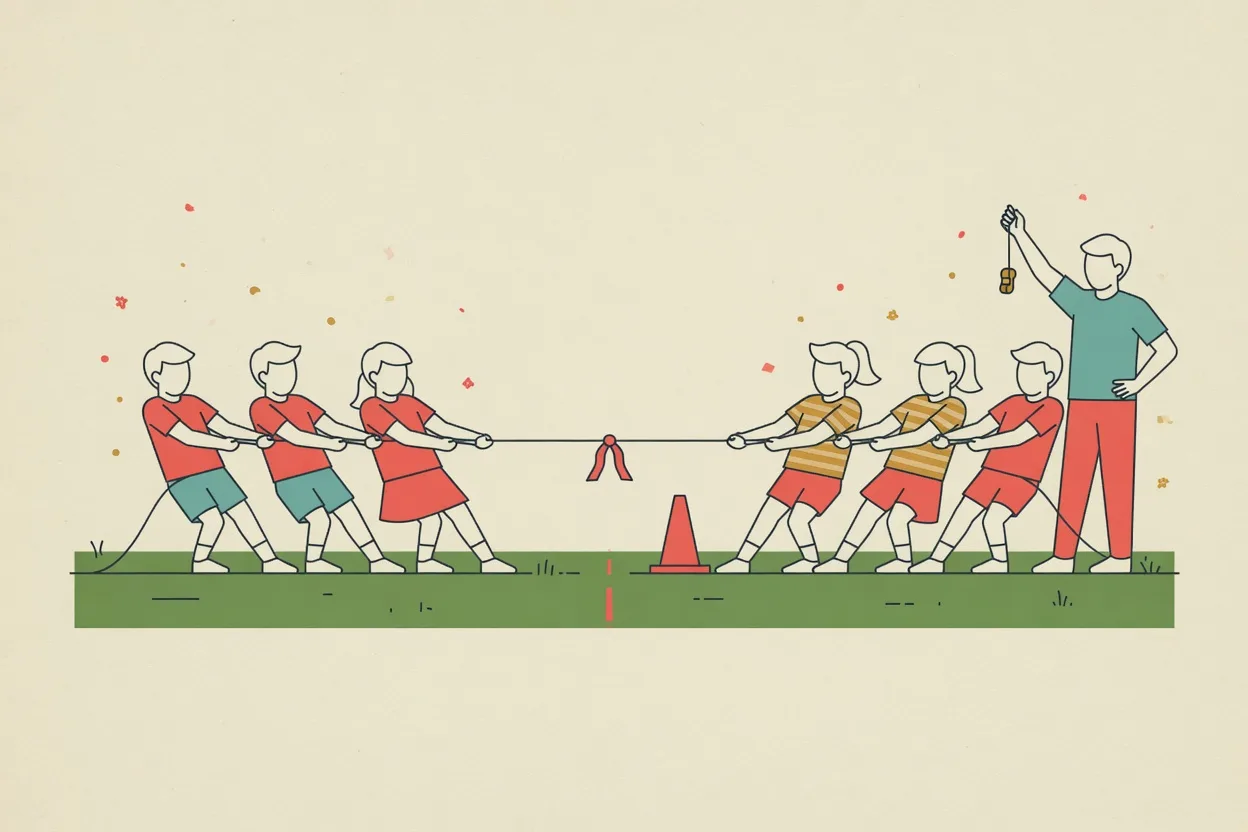
Tug of war looks like the simplest game at the party: two teams, one rope, pull. It is also the game most teams lose without ever understanding why. The side that wins is almost never the side with the most muscle — it is the side that sets its feet before the whistle, leans instead of yanks, and moves as one animal rather than eight people having eight different ideas. All of that is learnable in about ten minutes, which is why tug of war is such a satisfying game to teach a group of kids: they can feel themselves get better between the first pull and the third.
This guide covers the whole thing — the gear, the rules, the strategy, the technique, the tactics, the mistakes, the safety rules an adult has to enforce, and the age-by-age variations that keep it fun for five-year-olds and eleven-year-olds alike.
What you need to play tug of war
Very little, which is half the appeal. But the two things that matter — the rope and the ground — are worth getting right, because they are also the two things that cause every injury.
- The right rope. Soft-braided, at least an inch thick, long enough to give every puller an arm's length of space plus slack at both ends. Thin cord and clothesline cut into hands; frayed or knotted rope snags and burns. Run your palm down the whole length before you hand it to anyone.
- Grass, ideally slightly soft. Turf lets heels dig in and forgives the fall that ends every match. Never play on gravel, concrete or a wooden deck — when the rope goes, and it will, the losing team lands.
- Three markers. A ribbon or tape tied at the center of the rope, and two lines on the ground a few paces on either side of it. Chalk, cones, sweatshirts, garden stakes — anything the referee can see from the side.
- Sneakers with grip. No sandals, no bare feet, no rain boots. Feet are the whole engine of this game.
- One adult referee. Not optional. Someone has to own the start, the stop and the safety calls, and it cannot be someone holding the rope.
Tug of war rules, simply put
In the international sport, eight pullers a side face off in matched weight classes and win by dragging the rope's center marker four meters (about 13 feet) to their side. A birthday party needs a friendlier version, and this one works from about age six up:
- Split into two teams that match on total size, not just headcount. Four bigger kids against six smaller ones is usually fairer than six against six.
- Lay the rope out straight with the center marker over the middle line on the ground. Each team picks up its half and takes the slack up until the rope is taut and the marker is back over the line.
- The referee checks that everyone is standing, holding correctly, and clear of each other, then calls "Take the strain… pull!"
- The first team to drag the center marker past their own line wins the pull. At a party, two paces on either side is plenty — a longer distance just means a longer stalemate.
- Play best of three, and swap ends between pulls so nobody can blame the slope.
One rule is worth stating out loud before every match, because children will otherwise invent it for themselves: nobody lets go alone. If a team wants to stop, the referee stops the pull and both sides lower the rope together. A single kid releasing a taut rope puts an entire other team on the ground.
How to win at tug of war
There are only three levers, and they matter in this order. First, the order you put your team in — decided before anyone touches the rope, and worth more than any amount of effort. Second, technique: the grip, the stance and the lean that convert your team's weight into ground rather than into a red face. Third, timing — moving together, and choosing the right moment to take what the other team gives you.
Tug of war is not a strength contest. It is a contest of who can convert their weight into the ground most efficiently — and hold it there longest.
Hold that idea and the rest of this guide is just detail. The rope does not care how strong your arms are. It cares how much of your body weight is hanging behind the line, and whether your heels are anchored when the other side surges.
Tug of war strategy: how to order your team
The lineup is the single highest-leverage decision you make, and most teams get it wrong by simply grabbing the rope in the order they arrived. Here is the order that works:
The anchor goes at the very back
Your heaviest, steadiest puller takes the last position on the rope. The anchor's job is not to pull — it is to be immovable. They set the lowest, deepest stance on the team, and everyone in front of them is effectively pulling against that foundation. Put your lightest child here and the whole team slides, no matter how well the front seven are working. Choose for weight and calm temperament rather than for enthusiasm.
In the adult sport the anchor is allowed to pass the rope over one shoulder and across the back to lock it in. At a children's party, don't. Nobody wraps the rope around any part of themselves, anchor included — a wrapped rope cannot be dropped in a hurry, and being unable to let go is the one situation you never want a child in.
Your best technician goes first
The front puller — closest to the center marker — sets the angle for everybody behind them. If the lead stands upright, the whole line stands upright. Give this spot to the child who listens and copies well, not necessarily the strongest one. They are also the team's most visible metronome: everyone naturally times their steps off the front.
Everyone else fills in heaviest-to-lightest, alternating sides
Work backwards from the front with your remaining pullers roughly in descending size, and alternate which side of the rope each person stands on — one on the left, the next on the right, and so on. Alternating keeps the rope pulling straight down the middle. A team all standing on one side drags the rope diagonally and loses power to a sideways fight it cannot win.
Space out, and stay spaced
Roughly an arm's length between pullers. Bunched-up teams tread on each other's heels the moment they start stepping back, and the person who trips takes two teammates with them. Set the gaps deliberately while the rope is still slack, and the referee should check them before calling the strain.

Tug of war technique: grip, stance and the lean
This is the section that turns an average team into a hard one to beat, and it is entirely teachable in a few minutes on the lawn before the first match.
The grip
Both palms face up, hands about shoulder-width apart, and the rope runs along the side of your body — tucked in close under the arm, not held out in front of your chest. Palms-up is stronger than palms-down, and keeping the rope tight to your body means your skeleton is carrying the load instead of your shoulders. Elbows stay locked and straight throughout: your arms are hooks, not muscles. The moment somebody bends their arms they start doing a very tiring bicep curl against seven other children and contribute almost nothing.
Never loop, wrap or tie the rope around a hand, wrist, waist or shoulder. It is the one absolute rule, and it exists because a wrapped rope cannot be released when a team goes down.
The stance
Feet stagger front-to-back rather than sitting side by side, with the front foot pointing down the rope and the back heel dug hard into the turf. Knees bend, hips drop, and weight settles onto the back foot. The feeling to coach is "sit down onto a chair that isn't there" — kids get that instruction immediately, and it produces exactly the low center of gravity you want.
The lean
Here is where matches are won. From heels to shoulders, the body makes one straight line leaning back at roughly forty-five degrees, with the back flat and the chin up. You are not pulling the rope; you are hanging off it, letting gravity and your body weight do the work while your legs hold the position. Looking up rather than down keeps the chest open and the back straight — the instant a child looks at their feet, their back rounds, their hips come up and their weight goes forward onto their toes, where it is worth nothing.
45°
the backward lean you're coaching for
Palms up
the stronger grip, every time
Arm's length
spacing between pullers
0
wraps of rope around any body
The step
Ground is taken by walking backwards in small, flat steps on a call — never by heaving with the upper body. Short steps keep at least one heel loaded at all times. Long, greedy strides leave the whole team momentarily standing on nothing, which is precisely when a good opposition takes two feet off you.
Tactics and calls: winning the middle of a pull
Once both teams are set and leaning, a tug of war becomes a patience contest punctuated by short, brutal opportunities. Coach your team to spot them.
- Win the first three seconds. Get low and get the lean on before the referee's call, so that when "pull" comes you are already in position and the other side is still finding theirs. Teams routinely lose a foot of ground in the opening moment and never get it back.
- Hold before you pull. The default state is a steady, patient hold — heels in, arms straight, absorbing whatever comes. Frantic constant pulling burns a team out inside thirty seconds, and an exhausted team gives ground all at once.
- Use one voice. Appoint a caller — a teammate, a parent, or the entertainer running the games — and have the whole team step on the beat: "heave… heave… heave." Eight children pulling in rhythm beat eight stronger children pulling at random, every single time. This is the tip that visibly changes a match.
- Take what they give you. Watch the other side for the moment somebody re-grips, slips, stands up or looks down. That is the cue for two or three hard coordinated steps, then straight back into the hold.
- When you're losing ground, drop — don't panic. Sink lower, dig the heels harder, let their surge run out of steam, and counter as it fades. Answering a surge with a wild yank is how teams end up on their backs.
The five mistakes that lose tug of war
- Standing upright. No lean means no body weight in the fight, and it turns the game into an arm-wrestle you will lose.
- Bent arms. Exhausting, and it lets the rope creep. Lock them straight and forget about them.
- Pulling out of sync. A team without a rhythm spends most of its strength fighting itself. Add a caller and the same team suddenly looks twice as strong.
- Looking at the ground. It rounds the back, lifts the hips and shifts weight onto the toes. Chin up, eyes down the rope.
- The wrong anchor. Putting the smallest, most eager child at the back is the most common and most expensive mistake in party tug of war.
How to practice before the party
If a school field day or a family tournament is coming and your kids actually want to train for it, three drills cover almost everything:
- The wall sit. Back against a wall, knees at ninety degrees, hold. Tug of war is a leg-endurance sport disguised as an arm sport, and this builds the exact quality the hold demands.
- The static hold. Loop the rope around a sturdy tree, set the whole team in position and simply hold the lean for thirty seconds at a time. It teaches the body position without anyone winning or losing, which is the fastest way to fix technique.
- The rhythm walk. Rope in hand, no opposition, team walks backwards together on the caller's beat. Ridiculous to watch, and it fixes the single biggest weakness most teams have.
Tug of war for kids: variations by age
Ages 3–5
Skip competitive tug of war entirely. Little ones lack the balance to fall safely and the patience for a stalemate. Play "tug of peace" instead: the whole group on one end against one gently-losing grown-up, who staggers, protests and eventually goes down to enormous cheers. Keep the rope thick and short, keep the pull to a few seconds, and keep an adult inside the group.
Ages 6–8
The sweet spot. Teams of four to six, a short winning distance of a couple of paces, and best of three so the losing team gets a second chance while everyone still has energy. Teach the grip and the lean before the first pull and let them feel the difference on the second. Swap two players between teams if one side is running away with it — nobody minds at this age, and it keeps the game alive.
Ages 9 and up
Old enough for the real thing. Balance the teams by total weight rather than headcount, appoint anchors and callers, and run a real knockout bracket with a final. This is also the age where the strategy in this guide starts to visibly beat brute force, which is enormously satisfying for the smaller, cleverer team.

Fun tug of war variations
- Kids versus grown-ups. The undisputed crowd favorite. Stack every child in the party onto one end and two or three parents onto the other, and let the adults lose theatrically.
- The tournament. Four small teams, a knockout bracket, a third-place playoff and a final. Turns five minutes of game into twenty minutes of party.
- Four-way tug. Two ropes crossed and tied at the center, four teams pulling outward, first to reach their cone wins. Chaotic, hilarious, and it needs plenty of space.
- The sprinkler finish. On a hot day, put the sprinkler on the center line. Suddenly nobody minds losing.
- Silent tug. No talking allowed — the team has to find its rhythm without a caller. A brilliant way to prove to kids how much the caller was doing.
Tug of war safety: the adult's checklist
Tug of war is safe when an adult owns these six things, and genuinely risky when nobody does. Run through them before the first pull:
- Inspect the rope for frays, knots and stiffness, and keep both ends free — nobody holds the very tail.
- Nothing is ever wrapped or tied around a hand, wrist, waist, shoulder or fixed object.
- Clear at least six feet behind each team of tables, chairs, garden edging, glass and toddlers.
- Match the teams honestly by total size, and re-balance between pulls rather than letting one side dominate.
- Agree on the stop signal out loud beforehand — one whistle or one shout, and both teams lower the rope together.
- Play on grass, in sneakers, with a referee standing at the side of the center line where they can see both teams.
Frequently asked questions
- How do you win tug of war?
- Get your team order right, then your technique, then your timing: the heaviest, steadiest puller goes at the back as the anchor, and everyone else alternates sides down the rope. Get low with a straight back and a forty-five degree lean before the start call, then take ground in small coordinated steps on a caller's rhythm rather than pulling constantly.
- How do you win tug of war without strength?
- Use your body weight instead of your arms: the rope doesn't care how strong your arms are, only how much weight is hanging behind the line. Lock your elbows straight so your arms act as hooks, stagger your feet with the back heel dug into the turf, and sit back into a forty-five degree lean with your chin up, hanging off the rope rather than pulling it. Take ground in short, flat steps so a heel is always loaded.
- How do you win tug of war against a stronger team?
- Out-organize them: eight children pulling in rhythm beat eight stronger children pulling at random. Get low and leaning before the call so you don't lose ground in the first three seconds, hold steady rather than pulling constantly, and step together on one caller's "heave." When their surge comes, sink lower and dig your heels in until it fades, then take two or three hard steps the moment someone on their side re-grips, slips or stands up.
- Where should the strongest person be in tug of war?
- At the back: the last position on the rope is the anchor, and it should go to your heaviest, steadiest puller. The anchor's job is to be immovable, and everyone in front is effectively pulling against that foundation. Put your best technician at the front instead, because the lead sets the body angle for the whole line, then fill in the middle roughly heaviest to lightest, alternating sides.
- How do you win tug of war 1v1?
- The technique that wins team pulls wins one-on-one too: straight arms, a staggered stance and a deep lean, so your body weight does the work. Grip palms up with the rope tucked along your side, dig your back heel in and sit back at about forty-five degrees with your chin up. Hold steady rather than yanking, since constant pulling burns you out, and when your opponent re-grips, slips or stands up, take two or three short, hard steps back before settling into the hold again.
- How do you grip a tug of war rope?
- Both palms facing up, hands about shoulder-width apart, with the rope running along the side of your body and tucked close under the arm. Keep your elbows locked straight, and never wrap the rope around your hand, wrist or body.
- How many people should be on a tug of war team?
- Four to six per team works well at a children's party, while the international sport uses eight a side. Smaller teams are easier to balance, easier to referee and keep the pulls short enough that nobody loses interest. Match the teams by total size rather than headcount.
- What age can children play tug of war?
- From around six for the competitive version. Kids under five are better served by a cooperative game where the whole group pulls against one grown-up, because they do not yet have the balance to fall safely at the end of a real pull.
Tug of war is one of a handful of games worth building an afternoon around — see our complete guide to kids party entertainment for the games, acts and running order that pair well with it, or browse local entertainers if you would rather hand the whole thing to someone who does this every weekend.
Perfect for these parties
Themes that build a whole party around this game — with the food, the decor and a printable invite to match.