
6–12
Ages
2+
Players
Indoors or out
Where
5–10 min
How long
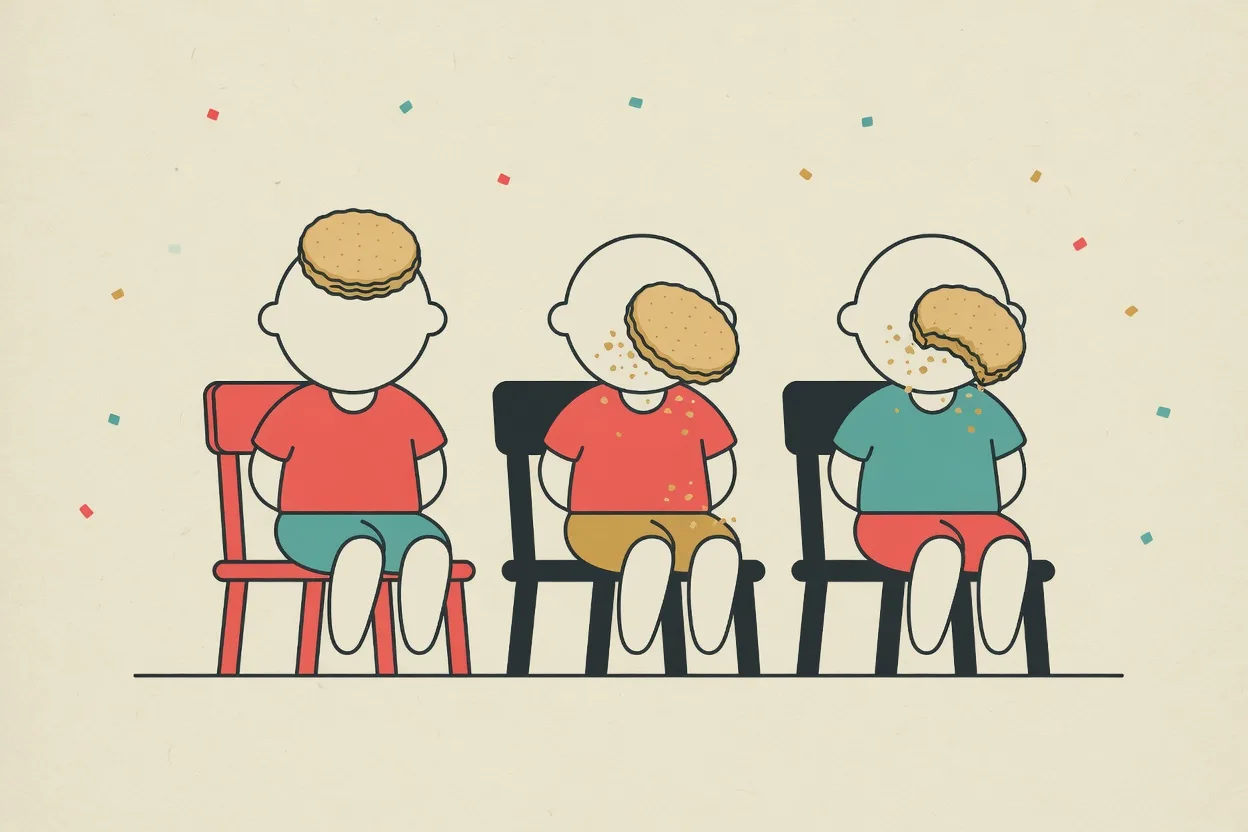
Cookie face is a minute-to-win-it staple for a reason: it needs one cookie and one chair per player, takes about thirty seconds a turn, and produces some of the funniest faces you'll see all year. The entire challenge is getting a cookie from your forehead into your mouth using nothing but your face — no hands, no help, no dignity. It's short, loud, and genuinely funny to watch, which makes it one of the best games to run when energy's flagging and everyone could use a laugh rather than another sprint.
This covers which cookies actually hold up to the job, how to make the no-hands rule stick, and the timing that turns it from a silly aside into a real competitive heat.
Picking the right cookie
A flat cookie with a bit of texture to it — an Oreo or a graham cracker square is close to ideal — grips the skin just enough to be moveable in stages rather than sliding straight off at the first attempt. Smooth wafers and delicate shortbread tend to slip or shatter before they've gone anywhere, which makes for a frustrating round rather than a funny one. Avoid anything with hard chunks or whole nuts, purely because a face full of concentration is not the moment for a stray bite to land wrong.
Enforcing no hands, and where it goes wrong
Telling children to keep their hands behind their back works for about the first ten seconds; after that, a hand starts creeping up "just to help", entirely without the child noticing they're doing it. Sitting on both hands solves this properly, since it's physically awkward to cheat and immediately obvious to everyone watching when someone tries. The other place this goes wrong is patience — the cookie needs several small head-tilts and face-scrunches to walk down, not one big movement, and children who try to rush it usually just flick the cookie onto the floor and have to restart. Tell them that before the first round, not after the first failure.
The cookie needs several small head-tilts to walk down, not one big movement. Children who try to rush it just flick it onto the floor.
Warm hands aren't required, but a quick reminder to sit up straight rather than slump in the chair makes a genuine difference — the cookie has further to travel and less gravity to work with on a slouched player.
Keep a stack of spare cookies within reach. Between the ones that crumble and the ones that end up on the carpet, you'll get through more than you'd expect, and running out mid-heat is a deflating way to end a round that was building nicely.
It's also one of the best spectator games on this list — children who've already had their turn will happily watch four or five more heats without getting bored, which is not something you can say about most party games.
Run it back to back with cup stacking for a full minute-to-win-it bracket, or check musical chairs if you want one more classic in the mix that needs no cookies at all.
What you need
- One flat, sturdy cookie per player per round, plus spares
- A chair per player
- A stopwatch
How to play cookie face
- Seat each player in a chair, hands held firmly behind their back or sat on for the whole round — no hands at all, from start to finish.
- Place one flat cookie on each player's forehead, centered just above the eyebrows.
- On "go", players tilt their head back and use only their face — scrunching their nose, working their eyebrows and jaw — to walk the cookie down towards their mouth.
- The cookie usually needs several small drops rather than one smooth slide; a player can adjust their head angle but their hands must stay put throughout.
- First player to get the cookie into their mouth and take a bite wins that round; a dropped cookie means starting again from the forehead with a fresh one.
- Run it as a straight knockout or just for the fun of watching the faces — either way, have spare cookies ready, because plenty end up in crumbs on the floor.
Variations
Team relay
Line players up in teams and race in relay — each player must get their cookie into their mouth before the next teammate starts, first team through the whole line wins.
Flavored heat
Run several short heats with a different cookie each time — a plain one is easiest, a chocolate-coated cookie slightly trickier once it starts to soften under warm skin, which adds a genuinely funny difficulty curve.
Blindfolded final (ages 9+)
For a joke final round with older children, add a loose blindfold as well as the no-hands rule — purely comic, since nobody can see the cookie slipping anyway.
Frequently asked questions
- What kind of cookie works best for cookie face?
- A flat, sturdy one with a bit of surface texture, like an Oreo or a graham cracker square — it's less likely to snap or slide straight off than a smooth wafer or a crumbly shortbread. Avoid anything with hard chunks or nuts, in case of a stray bite the wrong way.
- Why is cookie face also called the forehead cookie game?
- Both names describe exactly what happens: a cookie starts on the player's forehead and has to travel to their mouth using only facial movement, no hands. You'll see it under either name.
- How do you stop players cheating at cookie face?
- Have every player sit on their hands, not just hold them behind their back — it's much harder to sneak a nudge in when you're sitting on the evidence. One adult watching all players at once catches the rest.
- What age is cookie face suitable for?
- From about six, once a child can manage a mouthful of cookie unsupervised and has the patience for a few failed attempts. It's a genuinely funny game to watch at any age, so younger siblings can happily sit out and spectate.
Perfect for these parties
Themes that build a whole party around this game — with the food, the decor and a printable invite to match.