
3–10
Ages
4–20
Players
Indoors or out
Where
5–15 min
How long
Musical chairs is the game every adult remembers and almost every adult sets up wrong. It takes ninety seconds of preparation, needs nothing you do not already own, and reliably turns a room of drifting, over-sugared children into one shrieking mass with its eyes on the same thing. It is also, played carelessly, the fastest way to produce a crying five-year-old and a bruised shin. The difference between those two afternoons is entirely in how you run it — and the fixes take about two minutes to learn.
What follows is the version that works at a real birthday party: the setup, the rules, the judging, and the variations that keep the children who are out from wandering off to find the cake.
Why musical chairs works, and where it goes wrong
The game works because it is honest. There is no skill to master and no teams to argue about — one chair fewer than there are children, and the music decides. A four-year-old and a nine-year-old can genuinely both win, which is rarer in party games than you would think, and the round is short enough that nobody has time to get bored.
It goes wrong in three predictable places. The first is speed: children who are running rather than walking arrive at a chair with too much momentum, and two of them arriving at once is how the shin gets bruised. The second is the chairs themselves — anything with wheels, anything that folds, anything light enough to slide across a wooden floor will eventually tip with a child half onto it. The third is elimination. Getting out first, in front of everyone, at four years old, when there are twenty minutes of the game left to watch, is a genuinely miserable experience, and it is the thing that most often ends a game early in tears.
All three have straightforward answers. Make walking the rule and enforce it from the first round. Use dining chairs, patio chairs or nothing at all. And give the children who are out an actual job, which is the trick almost nobody uses.
Stopping the music without anyone crying foul
Whoever controls the music controls the game, and children work that out immediately. Stand with your back to the circle, or in the next room with the door open, and say so out loud before you start: I cannot see you, so I am not choosing. It sounds like a small thing. It removes about half the arguments.
Vary the length of each burst — eight seconds, then twenty-five, then five. Predictable timing lets the quick children hover by a chair and turns the game into a stalking contest rather than a walking one. If you are using a phone, build a playlist rather than one long track so you always have somewhere to jump to, and turn it up higher than feels sensible; a room of twelve excited children is louder than you remember.
The adult on the music should not be able to see the chairs. Say it out loud before the first round and half the arguments never happen.
What the children who are out actually do
This is the part that decides whether the game lasts. A child who is out and has nothing to do will either sulk on the sofa or rejoin the circle uninvited, and both end the game. So hand out roles as people go: the first child out becomes the chair remover, the second becomes the judge who calls close finishes, the third takes over the music, and after that they are the crowd — clapping, counting down, shouting for whoever is left.
Two other things help. Keep the rounds moving so that no elimination is ever more than a couple of minutes from the end. And if you are playing with kids under five, use one of the no-elimination versions below instead — at that age the sitting-down is the whole appeal, and being out is simply not worth it.
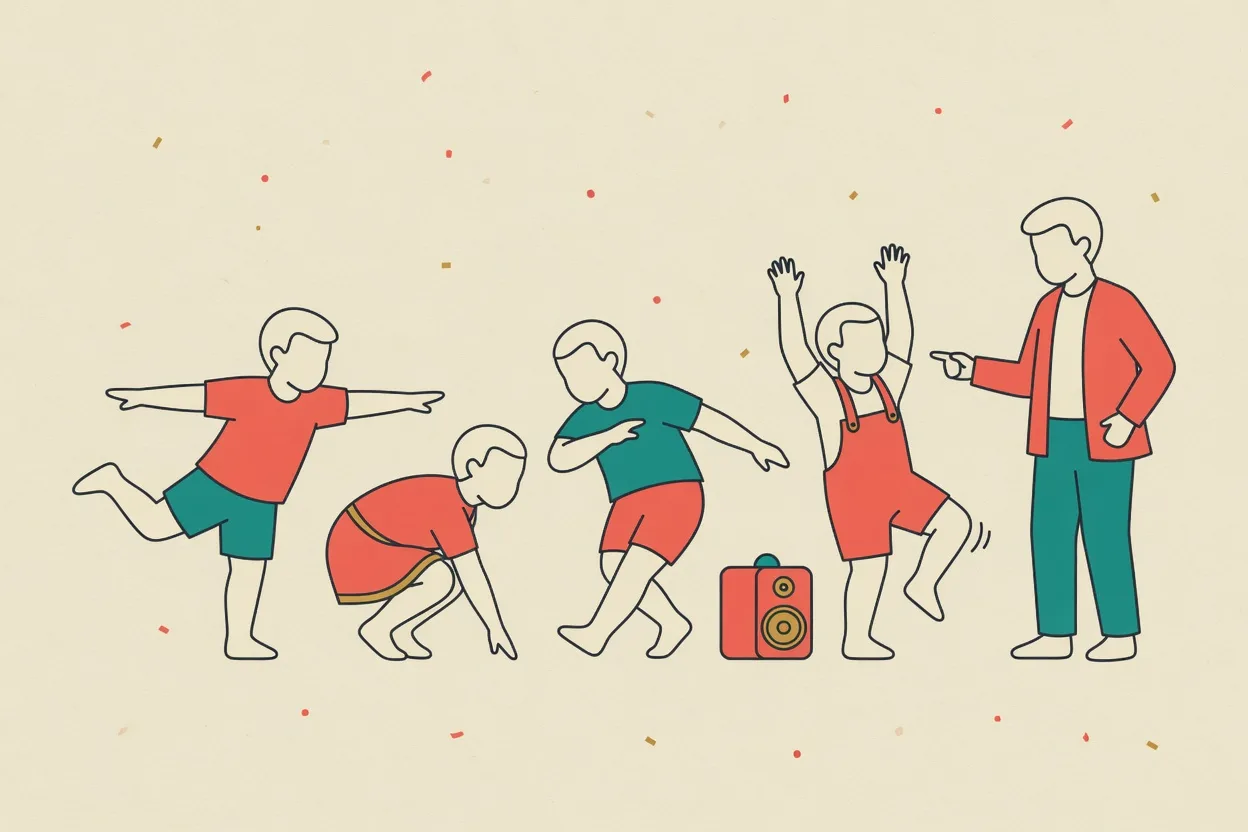
If the group is very young, or you simply want the same energy with none of the collision risk, musical statues does almost the same job with no furniture at all — and the two run beautifully back to back.
What you need
- One sturdy chair per child, minus one
- Music and a speaker loud enough to hear over a room of children
- A clear floor with an arm's length of space around the whole circle
- One adult on the music, positioned so they cannot see the chairs
How to play musical chairs
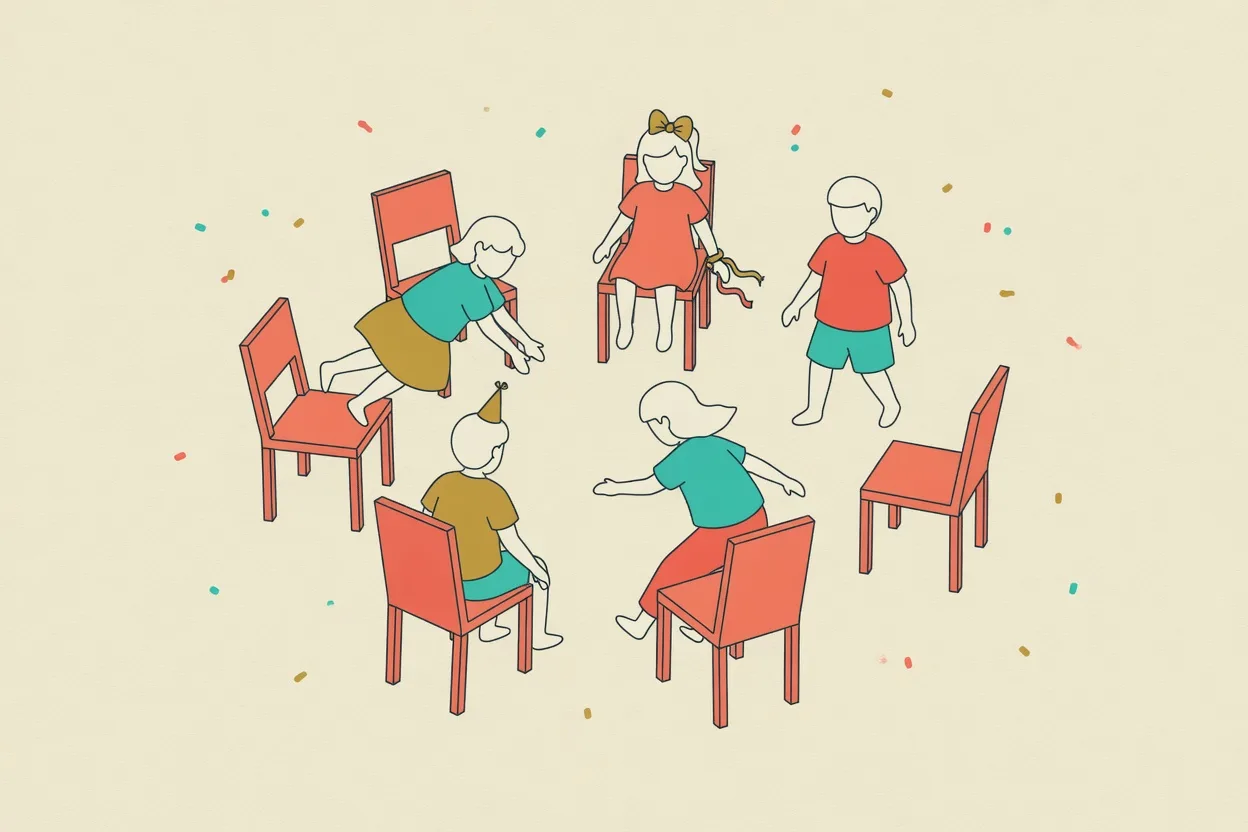
- Count the children and put out one chair fewer than there are players — four children, three chairs.
- Arrange the chairs in a circle facing outward, or in two back-to-back rows if the room is narrow, leaving an arm's length of clear floor all the way around.
- Have everyone stand in a ring outside the chairs, all facing the same direction so nobody is walking into anyone else.
- Start the music. Everyone walks — not runs — around the outside of the circle, in that one direction, until it stops.
- Stop the music at an unpredictable moment, from behind the group or out of sight of the chairs.
- Everyone sits down on the nearest free chair. One child will be left standing: they are out, and they become the chair remover for the next round.
- Take away one chair, restart the music, and play again with everyone who is still in.
- Keep going until two children are circling one chair. Whoever sits on that last chair wins.
Variations
Musical cushions (ages 3–5)
Swap every chair for a floor cushion, a paper plate or a chalk circle. Nobody can trip over a cushion and nobody can tip one up, which makes this the only version worth playing with three- and four-year-olds. It also lets you run it outdoors on grass with no furniture at all.
Nobody out
Remove a chair each round as usual, but nobody leaves the game — children have to share the chairs that remain. It ends with eight giggling children draped over two chairs, and it is by some distance the most popular version with kids under six. The last round is a photograph rather than a winner.
Silly walks
Call a different way of moving before each round: tiptoe, crab walk, dinosaur stomp, slow motion. It slows everybody down, which fixes the collision problem on its own, and it gives the older children something to compete at when the game itself is too easy for them.
Team chairs
For a big group, split into pairs holding hands and put out one chair per pair, minus one. Both children in a pair have to be on the chair when the music stops. Good for eight- to ten-year-olds who would otherwise find the original too simple, and it doubles the number of players a small room can hold.
Frequently asked questions
- How many chairs do you need for musical chairs?
- Always one fewer than the number of children playing: ten children, nine chairs. Remove one more chair after every round, so the count of chairs is always one behind the count of players still in the game.
- What age is musical chairs suitable for?
- Three and up, with a caveat — kids under five usually do better with the cushion version or the no-elimination version, because at that age being out first is more upsetting than the game is fun. The classic elimination game lands best between about five and ten.
- How do you stop musical chairs from getting rough?
- Make walking the rule, insist everyone travels the same way around the circle, and use heavy chairs that cannot slide or tip. Announce that a child who runs or pulls someone off a chair sits out the next round, then actually do it once — after that the rule enforces itself.
- Can you play musical chairs without chairs?
- Yes, and it is often better. Cushions, paper plates, hula hoops or chalk circles on a patio all work exactly the same way, take seconds to lay out, and remove every trip and tip hazard the furniture version brings.
- What is the difference between musical chairs and musical statues?
- Musical chairs is a race for a seat when the music stops; musical statues is a freeze — everyone dances, and anyone still moving after the music stops is out. Statues needs no equipment and no floor space, so it is the better choice for a crowded room or a very young group.
Perfect for these parties
Themes that build a whole party around this game — with the food, the decor and a printable invite to match.