
5–12
Ages
2+
Players
Indoors or out
Where
10–20 min
How long
Cup stacking looks deceptively simple on video — build a pyramid, knock it back down, done in a few seconds — and then genuinely humbling the first time you actually try it with real cups on a real table. That gap between watching and doing is exactly what makes it such a good party game: everyone thinks they'll be fast, almost nobody is on their first try, and watching the improvement across three or four tries is most of the fun.
Here's how many cups to use, what table height actually works, realistic times to aim for, and how to run a real bracket if you've got more than a couple of children wanting a turn.
Cups, tables and realistic times
Six identical cups is the right number for a party version — enough for a full three-two-one pyramid without the game demanding real practiced technique. Serious stackers use nine or twelve in more elaborate sequences, but that's a step up in difficulty most parties don't need. Plain plastic party cups work fine; dedicated stacking cups, sold in most toy stores around the same shelf as fidget toys, are a little lighter and stack slightly more predictably if you want to invest in a set that'll get reused.
Table height matters more than people expect. A player whose elbows are above the cups, reaching down at an angle, will consistently fumble more than one whose elbows sit level with or just below the stack — for younger children that often means a coffee table or even the floor, not the dining table you'd default to.
A tablecloth or a folded bath towel under the stacking area cuts down on both the noise and the bounce of a toppling pyramid, which matters more than it sounds like on a hard kitchen table with a room full of children watching closely. It's also worth doing one demonstration stack yourself first, slowly, so children see the three-two-one shape before they're racing against a clock — most first attempts fail because nobody was quite sure what shape they were aiming for, not because of a lack of speed.
Where it goes wrong, and running a bracket
The most common mistake is racing before anyone's had a practice turn. A confident, practiced child can stack and collapse six cups in five to ten seconds; an absolute first attempt is often two or three times that, and treating that first slow attempt as the "real" result puts children off before they've had a fair chance to improve. Give everyone one practice round that doesn't count, then start the actual timing. For a bracket with more than four or five players, run head-to-head pairs at the same table rather than one at a time against a stopwatch — a direct race is more exciting to watch and to lose than a number on a screen.
Everyone thinks they'll be fast. Almost nobody is, on the first try — and watching that gap close across three or four tries is most of the fun.
It runs well alongside cookie face as a two-game minute-to-win-it bracket, and musical chairs if the group wants a third round afterwards that needs no table, no cups, and no practice turn at all.
What you need
- Six identical plastic cups per player, plus a couple of spares
- A flat, stable table at a comfortable height
- A stopwatch
- Tape, to mark each player's space
How to play cup stacking
- Give each player an identical stack of cups — six is plenty for a party version; eager or older children can go up to ten for a longer cascade.
- Set players up at a flat, stable table, spaced out with a marked space each so elbows don't collide mid-stack.
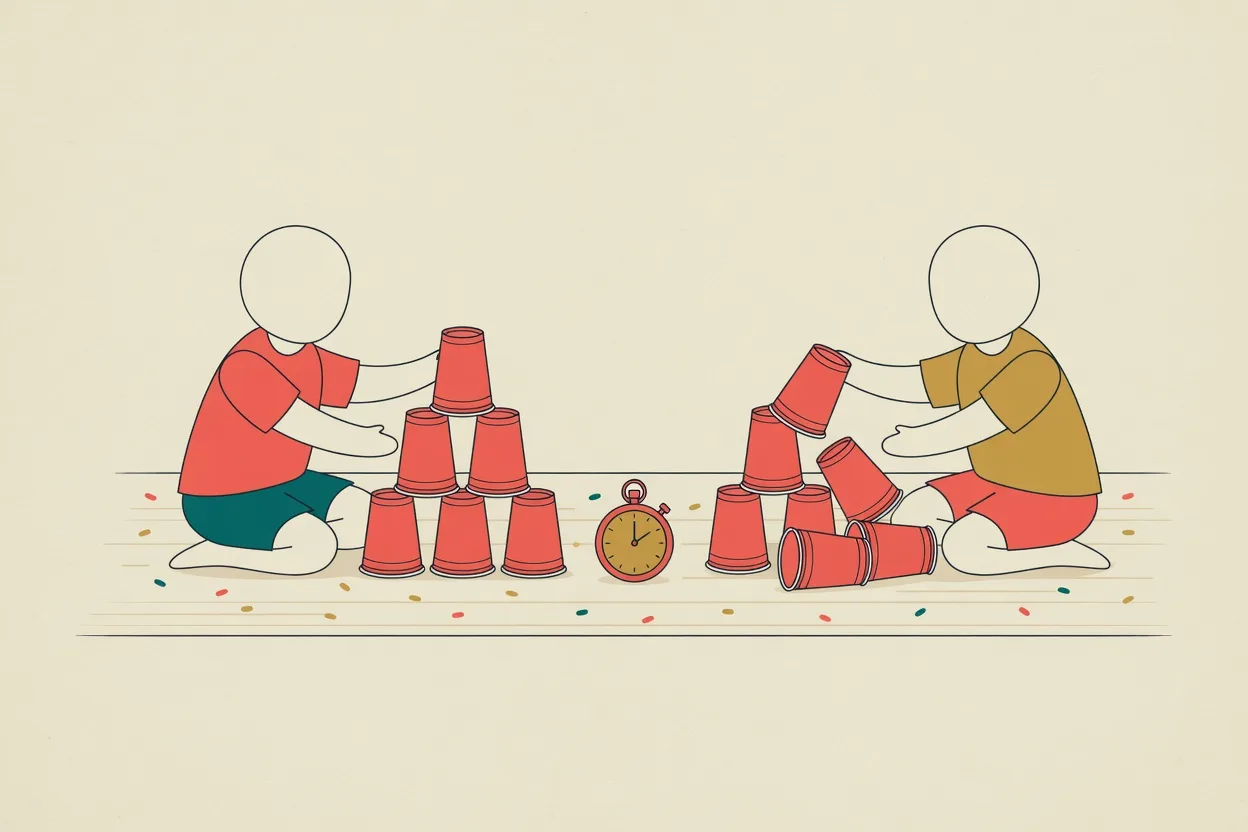
- On "go", each player builds their cups into a pyramid — for six cups, three on the bottom row, two on the next, one on top — as fast as they can.
- Once the pyramid is complete, they immediately reverse it, unstacking cup by cup back into a single tower or pile.
- The clock stops the moment the last cup is back down; fastest complete stack-and-collapse wins the round.
- Run it as individual timed turns and compare times, or race two players side by side on the same table for a straight head-to-head.
Variations
Head-to-head bracket
Run it as a straight knockout — pairs race side by side, the faster of the two goes through to the next round, until a single final decides the party champion.
Ten-cup cascade (ages 9+)
Step up to ten cups in a full pyramid — four, three, two, one — for older or more practiced children. It takes real technique rather than just speed, and is worth teaching in a practice round before it counts.
Relay stack
In teams, each player stacks and collapses their own set before tagging the next teammate in — turns an individual timed game into a team relay, and means slower stackers aren't racing the clock alone.
Frequently asked questions
- How many cups do you need for the cup stacking game?
- Six per player is a good party standard — enough for a full pyramid without taking too long to master. Serious stackers use sets of nine or twelve, but that's more than most parties need.
- What is a good time for the cup stacking game?
- A confident child can stack and collapse six cups in five to ten seconds once they've had a couple of practice tries; first attempts are often two or three times that, which is completely normal and part of the fun of comparing times.
- What table height works best for cup stacking?
- Whatever height lets every player's elbows sit comfortably at or just below the cups without stretching up or hunching over — for younger children that often means a coffee table or the floor rather than a full-height dining table.
- What age is the cup stacking game suitable for?
- From about five, once a child has the fine motor control to place a cup precisely rather than just knock it in the right direction. It's also a genuinely good game for a wide age range playing side by side, since everyone is racing their own previous time as much as each other.
Perfect for these parties
Themes that build a whole party around this game — with the food, the decor and a printable invite to match.