
5–12
Ages
4+
Players
Indoors
Where
15–25 min
How long
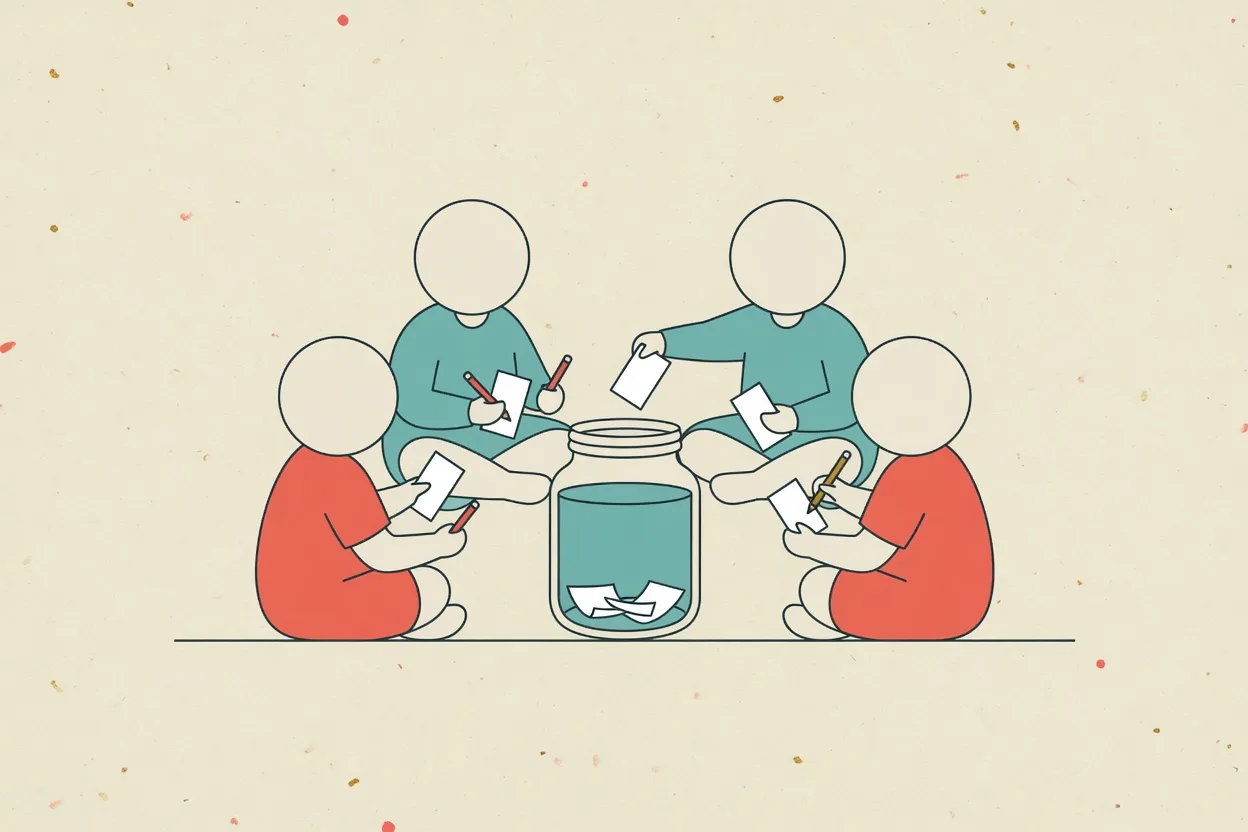
Worth saying plainly first: the wishes time capsule game is an activity, not a race or a contest, and there's no winner at the end of it. It earns its place on a New Year's list anyway because it's the one thing on this occasion that gives children a genuine reason to sit still for ten minutes, and because — unlike most party games — it isn't over when the party is. Every child writes down a wish or a hope for the coming year, chooses whether to read it aloud or seal it away unseen, and the sealed slips go into a capsule that doesn't get opened until the same time next year.
What follows covers running the write-and-seal round properly, what to actually use as a capsule, and the reveal date — the part hosts most often forget to plan for, which is what turns this from a nice idea into a promise nobody keeps.
Running the write-and-seal round
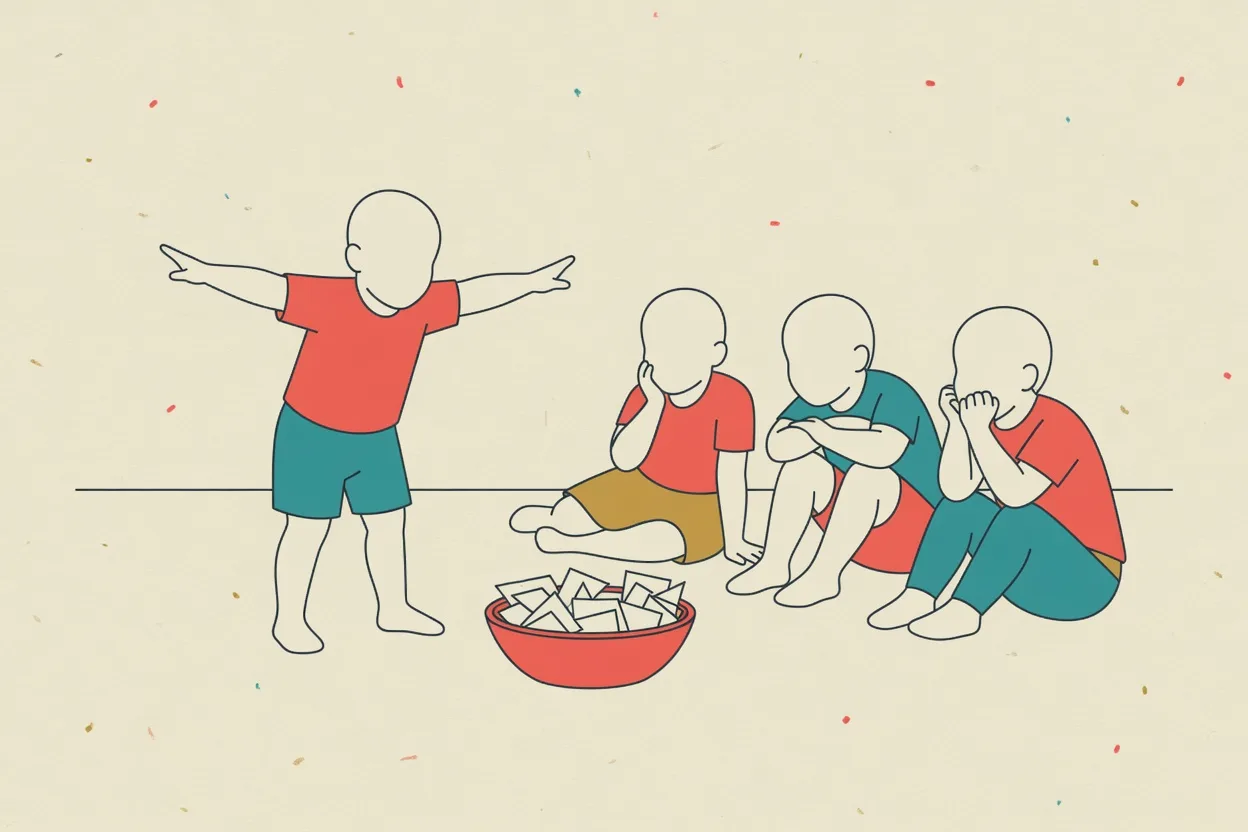
Give every child paper and a pencil and a genuinely simple prompt: one thing you hope happens this year, or one thing you want to get better at. Keep it that open — a specific prompt like "what's your resolution" is a word an eight-year-old barely understands and a five-year-old doesn't at all. Let children take a few minutes to write or draw, then go around the circle one at a time. Each child chooses, out loud, whether to read their wish to the group or fold it and drop it straight into the capsule unseen — that choice is the actual game mechanic, and it's what stops the round feeling like homework.
Non-writers are not a problem to solve so much as a thing to plan for from the start: have an adult or an older sibling on hand to write down what a four- or five-year-old says out loud, word for word, rather than asking them to write it themselves. A drawing works just as well as a sentence for that age, and sealing a drawing into the jar unseen is exactly as satisfying to a small child as sealing a sentence.
The capsule, the reveal, and where this goes wrong
The capsule itself can be anything with a lid — a mason jar, a cookie tin, a large envelope sealed with tape and everyone's initials on the flap. What matters far more than the container is the reveal date, and this is genuinely the paragraph that decides whether the game works: pick an actual date — next New Year's Eve, the child's next birthday, whatever occasion suits the family — write it on the outside of the capsule in permanent marker, and put the capsule somewhere a parent will actually find it in a year's time. A capsule that gets put away in a drawer and forgotten isn't a broken game, but it does waste the entire point of it, and it's the single most common way this activity fails.
If you're running a full New Year's lineup, this sits naturally as the calm activity on either side of the noisier moment — the balloon drop countdown straight after works well, since children who've just sealed a quiet wish are ready for something loud. For another circle activity that needs the same one-at-a-time structure, the telephone game or a round of charades fits the same slot just as easily.
What you need
- One slip of paper and a pencil per child
- A jar, cookie tin or large envelope to act as the capsule
- A calendar, planner or phone note for the reveal date
- A small table or clipboard for younger children to write against
How to play wishes time capsule game
- Give every child a slip of paper and a pencil, and set out the prompt: one thing you hope happens, or want to get better at, this year.
- Let children write or draw their wish for a few quiet minutes, helping any non-writer by writing down what they say out loud.
- Sit everyone in a circle and go around one at a time.
- Each child chooses out loud whether to read their wish to the group or fold it and drop it straight into the capsule unseen.
- Once everyone has had a turn, seal the capsule — lid on, envelope taped shut — with everyone watching.
- Write the reveal date clearly on the outside, and put the capsule somewhere it will genuinely be found again on that date.
Variations
Family capsule
Have every adult in the room write a wish alongside the children and seal it in with theirs. It removes any awkwardness about being the only one whose wish is being read or hidden, and the reveal a year later is a much better moment when the grown-ups' wishes are in there too.
Draw instead of write (ages 3–5)
Skip words altogether for the youngest children and let them draw a picture of something they're looking forward to instead. Fold and seal it exactly the same way — the sealing and the reveal are the part that lands with this age group, not the writing.
Frequently asked questions
- What do you need for the wishes time capsule game?
- Paper and a pencil per child, and a jar, cookie tin or large envelope to act as the capsule. Nothing else is essential, though a specific reveal date written on the outside is what makes the activity actually work a year later.
- Is the wishes time capsule game a real competitive game?
- No, and it isn't trying to be — there's no winner. It's a structured writing activity that gives children a share-or-seal choice to make, which is what keeps it feeling like part of the party rather than a craft table off to one side.
- How do you handle a child who can't write yet?
- Have an adult or an older child write down what they say out loud, or let them draw a picture instead of a sentence. Both seal into the capsule exactly the same way, and both are just as meaningful to open again a year later.
- What should you actually do with the capsule after the party?
- Write the reveal date on the outside in permanent marker and put it somewhere a parent will genuinely rediscover it — a specific shelf, a phone reminder, or a calendar note. A capsule that gets lost in a drawer is the main way this activity fails.