
7–14
Ages
2+
Players
Outdoors
Where
10–20 min
How long
The wheelbarrow race is the one pairs game in this library where the partnership is completely literal — one child is, for the length of the course, being carried by the other. The front partner walks the whole way on their hands; the back partner holds their ankles and sets the pace. That is a genuine test of arm and shoulder strength for whoever is up front, more than most parents expect going into it, and it is exactly why the grip and the ground matter more here than in almost any other race at the party.
This guide covers the grip that actually holds a pair together, the technique that turns a wobbly few seconds into a real contest, and the one safety rule — grass, always — that isn't optional.
The grip that actually works
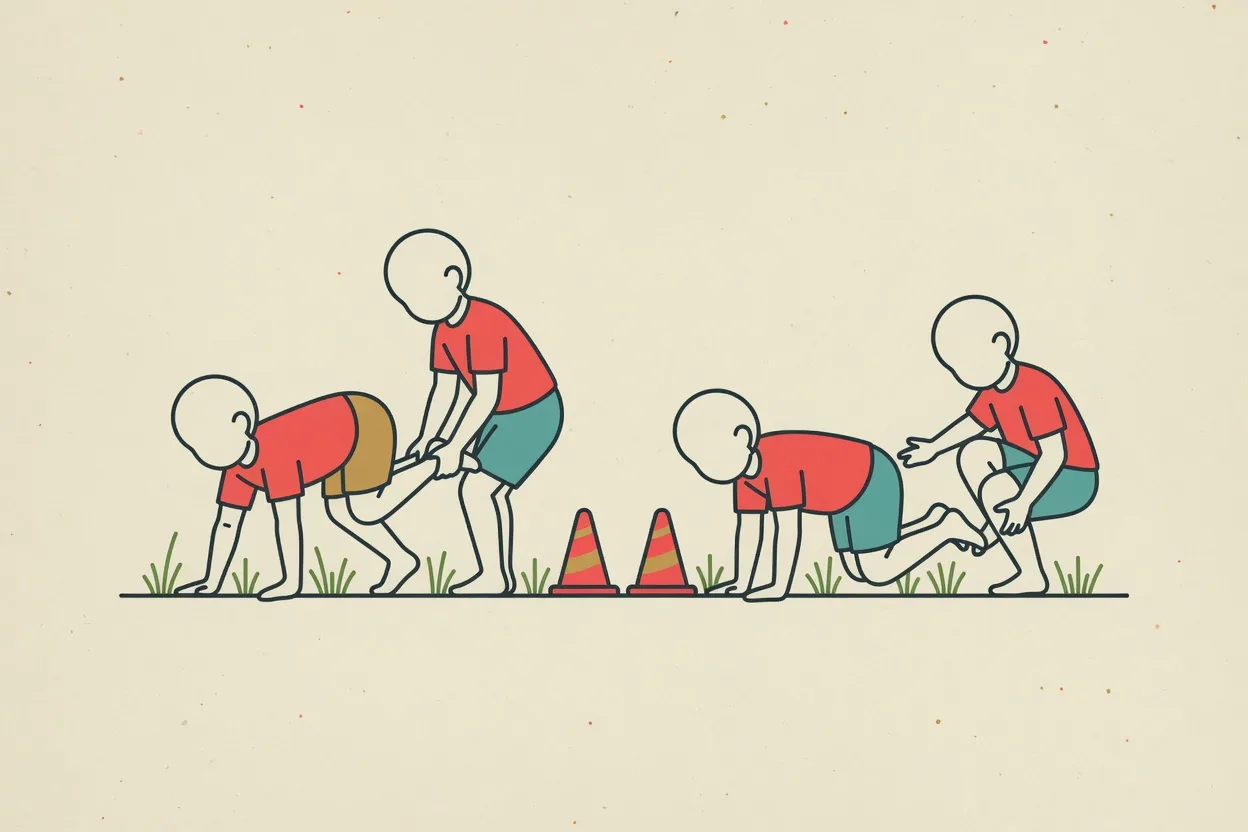
Hold the ankles, not the feet and not further up the shin — one ankle in each hand, at around hip height, with your arms fairly straight rather than bent. Holding too high forces the front partner's head down toward the ground, which is both harder to walk in and makes it much easier for them to overbalance forward. Match their pace rather than pushing or dragging: the back partner's job is to steady and steer, not to power the pair forward, and a back partner who marches ahead of what the front partner's arms can manage is the single most common reason a pair comes apart mid-race. Looking up rather than down helps the front partner too — exactly as in a sack race or three-legged race, where you look goes a long way toward where your weight ends up.
Why this one needs grass, no exceptions
In every other race in this library, a fall is a minor thing — you get up, brush off, keep going. A wheelbarrow race fall is different, because the front partner is already down on their hands with their weight forward, and if their arms give out they have nowhere to go but straight down onto their palms, wrists or face. On grass, that is a soft, forgiving stumble. On a patio, a path or any hard surface, the same fall grazes palms and can badly jar a wrist. Play this one on grass without exception, keep the course short — fifteen paces is plenty, since arm fatigue sets in fast — and if either partner in a pair is visibly struggling, let them stop and swap roles rather than push through to the finish.
Pair by strength more than by height or friend group where you can. Two children of similar build keep a matched pace naturally, while a strong front partner paired with a back partner who cannot keep up — or the reverse — turns technique into a tug of war between two mismatched speeds. Short on evenly matched pairs? Put the stronger child at the front and have the back partner deliberately set a gentler pace instead.
Run it as one leg of a bigger relay race, or alongside a three-legged race and a sack race for a full backyard field day. Browse local entertainers if you'd rather someone else paired everyone up.
What you need
- Flat, soft grass — this is a hands-and-knees-height race, so the ground matters more here than almost anywhere else in this library
- A short, clearly marked course, about fifteen paces, with a start and a finish or turning point
- Roughly matched pairs — similar strength matters more than similar height
How to play the wheelbarrow race
- Pair children up, roughly matched for size and strength rather than by height alone, and line pairs up at the start.
- One partner in each pair gets down on hands, and the other stands behind and lifts their ankles, holding one in each hand at about hip height — this is the "wheelbarrow".
- On "go", the front partner walks forward on their hands while the back partner walks behind, holding the ankles steady and matching their pace.
- First pair to reach the finish line, still connected, wins. If a pair comes apart, they reset at the point they fell, hands and ankles reconnected, and keep going.
- For a relay or a there-and-back course, swap roles at the halfway point or the turn so both children get a turn as the "wheelbarrow".
Variations
Wheelbarrow relay
Run it as one leg of a bigger relay — each pair does a short wheelbarrow stretch, swaps back to standing, and tags the next pair. Keeps any single pair's time on their hands short, which matters for younger or less strong children.
Obstacle wheelbarrow
Add two or three gentle obstacles to the course — around a cone, over a very low, soft cushion, never anything the front partner has to lift their hands high to clear. Best kept for pairs who have already managed a straight course comfortably, since obstacles add real difficulty to a game that is already testing arm strength.
Grown-up and child pairs
An adult as the "wheelbarrow" and a child steering by the ankles, or the reverse for an older, stronger child paired with a smaller adult. Slower, sillier, and takes the strength requirement out of it almost entirely, which makes it a good option for a mixed-age family game.
Frequently asked questions
- How do you hold someone properly in a wheelbarrow race?
- Grip the ankles, one in each hand, at around hip height, rather than the feet or further up the shin. Match the front partner's walking pace rather than pushing or dragging them, since a mismatched pace is what pulls a pair apart.
- What age can children do a wheelbarrow race?
- The hands-walking front role needs real arm and shoulder strength, so it works best from about seven or eight. Younger children can still play as the back partner, steering by the ankles, paired with an older child or an adult up front.
- Why do you need grass for a wheelbarrow race?
- Because the front partner is already down on their hands with their weight forward, and a fall lands on the palms, wrists or face rather than the feet. Grass turns that into a soft stumble; a hard patio or path does not.
- What's the best way to win a wheelbarrow race?
- A steady, matched pace beats raw speed — the back partner steers and steadies rather than pushing, the front partner keeps their arms fairly straight and looks up rather than down, and neither partner tries to go faster than the front partner's arms can actually manage.