
5–12
Ages
4+
Players
Indoors
Where
15–30 min
How long
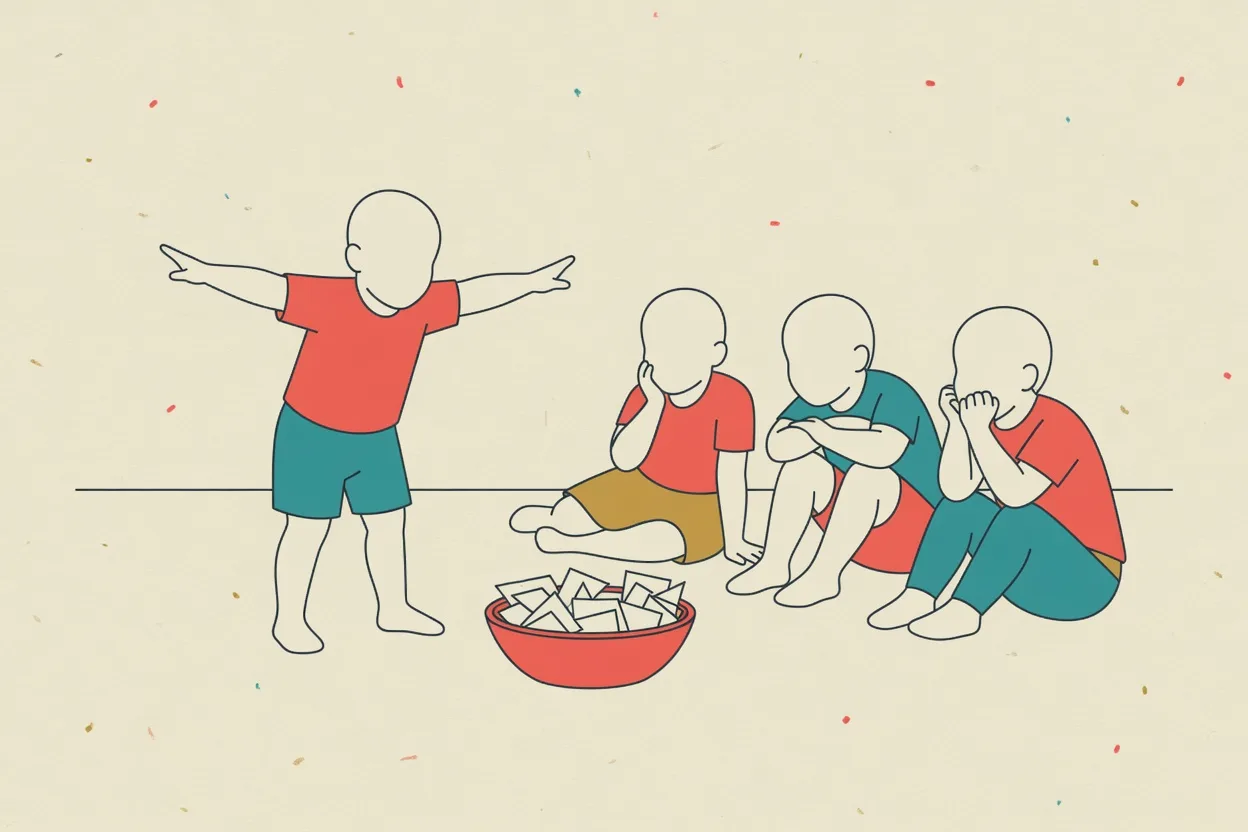
Charades is one of the few party games that scales cleanly from a five-year-old to a twelve-year-old, as long as the prompts do the scaling rather than the rules. One player silently acts out a word or phrase; everyone else shouts guesses until someone lands on it or time runs out. No talking, no props, no mouthing the words — just gesture, expression and increasingly desperate pointing.
The rules genuinely don't change with age. What changes is entirely the prompt list: an elephant or brushing your teeth works for a five-year-old acting for the first time; a nine-year-old wants movie titles and jobs with a bit more to physically work with. Write three separate lists by age before the party starts, rather than one list everyone draws from, and the game stays exactly as fun for the youngest child as the oldest.
Prompts that actually work
The best charades prompts have something obviously physical to grab onto — an action, a shape, a distinctive walk — rather than being abstract or purely verbal. Animals are close to foolproof for younger children: every child knows how to be a monkey, and there's no ambiguity to accidentally guess wrong. For seven and up, jobs (firefighter, chef, soccer player) and simple movie or book titles work well, as long as you stick to things the whole group has actually seen or read — a brilliant prompt nobody recognizes is just a silent, confusing minute for everyone involved. Write ten to fifteen prompts per age band onto individual slips before anyone arrives; deciding prompts on the spot mid-party is where the game slows to a crawl.
A few prompts always land better than expected and a few fall completely flat, and that's fine — the flat ones are usually over almost as quickly as they started. What matters more is a genuine spread of difficulty in each round, so the same one or two children aren't the only ones who can act well enough to be guessed quickly. Play one demonstration round yourself before handing the hat to the children — acting out something simple and slightly ridiculous shows a nervous first actor exactly how much silliness is allowed, which is usually more than they'd have guessed on their own.
Keeping the guessing under control
What goes wrong with charades for kids almost never happens in the acting; it's what goes wrong around it. A group excited to guess correctly first tends to shout over each other, and the loudest child ends up winning most rounds regardless of who actually worked it out — which stops feeling fair to everyone else within about three turns. Set a simple rule before you start: one voice at a time, and the actor points to whoever's turn it is to guess next rather than taking the first shout. It costs almost nothing in pace and makes the quieter children's guesses actually count for something.
If the group enjoys watching a message travel and change, the telephone game has the same comic reveal at the end, with whispering standing in for acting — or browse local entertainers if you'd rather someone else brought a ready-made prompt list and ran the whole thing.
What you need
- A list of prompts split by age — animals, jobs, movies or books work well
- A hat, bowl or bag to draw folded prompts from
- A watch or phone to time each turn (optional)
How to play charades
- Write age-appropriate prompts onto individual slips of paper — animals and simple actions for younger children, jobs, movies or books for older ones — and fold them into a hat or bowl.
- Split into two teams, or play free-for-all if the group is small.
- One player draws a prompt and acts it out silently — no talking, no mouthing words, no props.
- Their team, or the whole group, calls out guesses until someone gets it right or a set time runs out.
- Rotate who's acting each round, giving every child a turn, until the prompts run out.
Variations
Free-for-all (small groups)
Skip teams entirely and let anyone shout the answer at any point; whoever guesses correctly acts next. Works better than the team version for groups under about eight, where splitting into teams just leaves each side with only one or two guessers.
Reverse charades
Instead of one player acting for everyone else, the whole team acts out the prompt together while one player guesses. Genuinely funny to watch with six or more children all miming the same thing at once, and it suits a group who already know the standard version well.
Simplified, for kids under seven
Drop the timer, allow a little help from the audience ("is it an animal?"), and keep every prompt to single, obvious actions. Removes the pressure that makes younger children freeze up mid-turn, while keeping the core silent-acting idea intact.
Frequently asked questions
- What age can children play charades?
- From about five, as long as the prompts are simple and physical — animals and everyday actions rather than anything abstract. Keep separate prompt lists by age if your group spans a wide range, so nobody's stuck with a word too hard or too babyish for them.
- What are good charades prompts for kids?
- Anything with an obvious physical action: animals, everyday jobs, simple movie or book titles the whole group actually knows. Write ten to fifteen per age band onto slips before the party starts, rather than inventing them on the spot.
- How long should each charades turn be?
- Ninety seconds to two minutes is plenty for most prompts and keeps the game moving. Younger children often don't need a strict timer at all — the turn naturally ends once the prompt's been guessed or everyone's given up.
- Can you play charades without teams?
- Yes — free-for-all, where anyone can shout a guess and whoever's right acts next, works better than teams for smaller groups. Teams suit eight or more players, where splitting up keeps every child close to their own turn.
Perfect for these parties
Themes that build a whole party around this game — with the food, the decor and a printable invite to match.