
3–10
Ages
3+
Players
Indoors or out
Where
15–25 min
How long
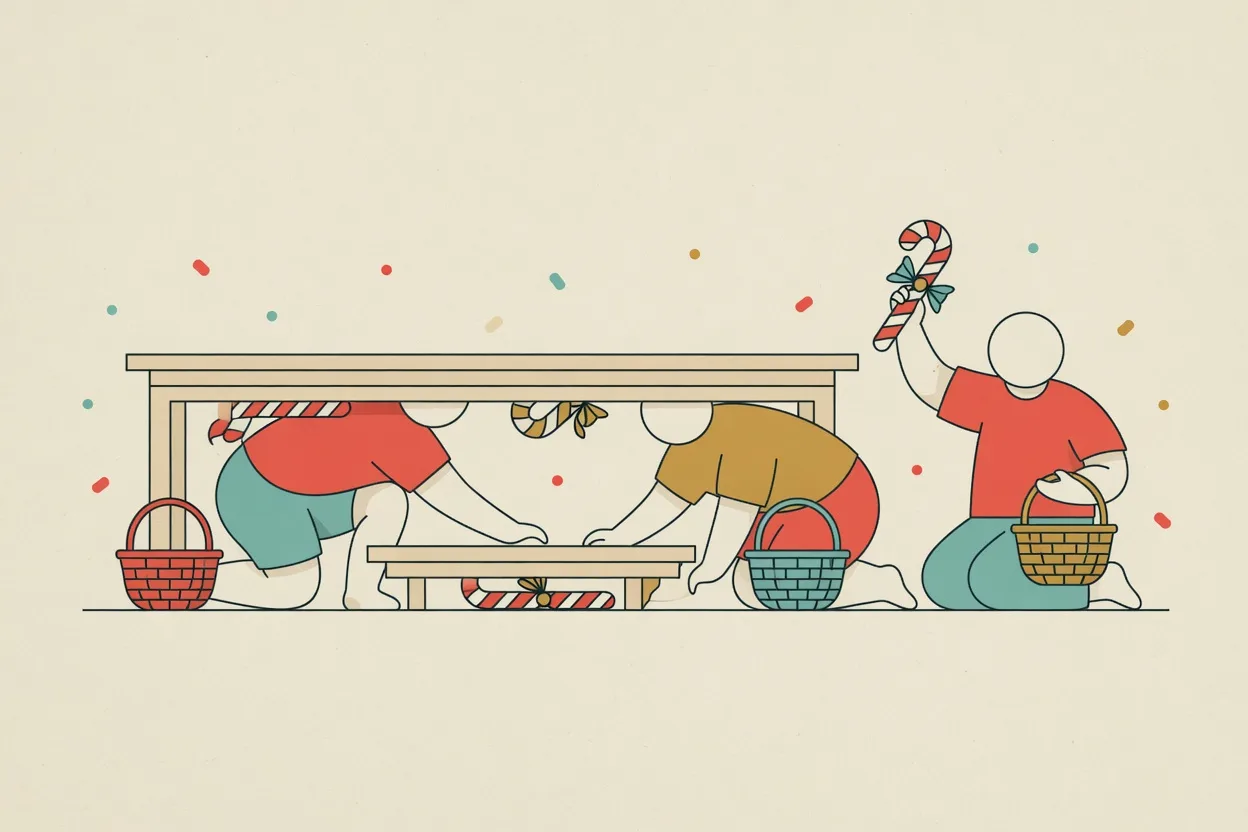
A candy cane hunt is an Easter egg hunt wearing a Christmas sweater — the mechanics are identical, hide small treats, send children off to find them — but candy canes hide differently from eggs. They're long, thin, and surprisingly good at disappearing behind a curtain or under a sofa, and the age range at a December party is often wider than at an Easter one.
Here's how many canes to hide, the color-coding trick that makes a hunt genuinely fair when a three-year-old and a ten-year-old are both playing, and where they always end up forgotten.
Making it fair across ages
The single best fix for an uneven hunt is color-coding: tie a small ribbon, or wrap each cane in a different color of cellophane, one color per child, and tell everyone only their own color counts. It completely removes the problem of a fast eight-year-old clearing the whole yard before the youngest child has found a single one, without slowing the older children down or making the game feel babyish for them — they're still hunting properly, just for their own set.
Vary the hiding height deliberately rather than at random — floor level and low shelves for the youngest hunters, and genuinely tricky spots, behind books or inside a shoe, reserved for children old enough to enjoy the challenge rather than get frustrated by it.
A dozen canes per child is a good target. It's enough for a hunt that lasts a full fifteen to twenty minutes without turning the hiding itself into a chore, and buying a few spares is worth it since candy canes do occasionally snap in the bag before you've even started.
Buy the canes a week or two ahead rather than the day before — supermarket stock of individually wrapped candy canes has a habit of thinning out in the lead-up to Christmas, and hunting for hunt supplies the morning of the party is not how you want to spend it. It's also worth checking the wrappers are still sealed once you've hidden them; a cane that's cracked inside its wrapper from being handled too much is a disappointing find.
Where it goes wrong
The most common problem isn't the hunt, it's the count afterwards. A candy cane hidden well enough to be genuinely fun to find is also hidden well enough for you to forget about it entirely — behind a radiator, under a sofa cushion, tucked into a potted plant — and it will absolutely turn up months later smelling faintly of upholstery. Keep a written or photographed list of exactly where you hid each one as you go, not from memory afterwards, and do your own final sweep once the children are done, using that list rather than trusting the room looks clear.
A candy cane hidden well enough to be fun to find is hidden well enough for you to forget about it. Write the list down as you go.
It pairs naturally with the calmer left right game as a wind-down, or send everyone straight into an indoor snowball fight first if they need to burn off energy before a hunt that rewards patience over speed.
What you need
- Individually wrapped candy canes, a dozen per child plus spares
- Ribbon or colored cellophane, to tag canes by child
- A small bag or basket per child
- A hiding area — living room, backyard, or both
How to play the candy cane hunt
- Buy or tag enough individually wrapped candy canes for every child to find the same number each — a dozen per child is a generous, satisfying hunt without taking all afternoon to hide.
- If you have a wide age range, color-code them: tie a small ribbon or use different colored cellophane to give each child their own color, and tell them only their color counts.
- Hide the canes around the room or yard while the children wait somewhere they can't see, from easy spots at floor and eye level for the youngest hunters to trickier ones for the oldest.
- Give each child a small bag or basket, say "go", and let them hunt for their own color, or for anyone's if the ages are close together.
- Set a rough time limit or simply call it once most bags are close to full, and do a final "last three hidden" call-out so nobody feels they were beaten right at the end.
- Do a quick group recount together at the end — it's a nice calm moment after the scramble, and catches anyone who's missed an obvious one.
Variations
Team hunt
Split into pairs of an older and younger child hunting together, sharing one bag — evens out the age gap without needing color-coding, and the pairing is often sweeter than the hunt itself.
Clue hunt (ages 7+)
Instead of hiding canes in plain sight, leave a short written clue at each hiding spot pointing to the next one, so the "hunt" becomes a real trail rather than a scramble — good for older children who'd otherwise finish a simple hunt in two minutes.
Golden cane
Hide one specially marked cane — a different color ribbon, or an actual gold one — somewhere trickier than the rest, worth a small extra prize to whoever finds it. Gives the hunt a real climax once the easy ones are gone.
Frequently asked questions
- How many candy canes do you need for a candy cane hunt?
- A dozen per child is a good target: enough for a hunt that lasts a full fifteen or twenty minutes without turning into a chore to hide. Buy a few spares in case any snap in the bag or go missing the day of the party.
- How do you make a candy cane hunt fair for different ages?
- Color-code the canes with ribbon or colored cellophane, one color per child, and tell each child only their own color counts. It stops a fast eight-year-old clearing the yard before a three-year-old finds their first one.
- Indoors or outdoors for a candy cane hunt?
- Either works. Indoors is easier to control in cold or wet weather and lets you hide canes at different heights around furniture; a backyard gives you more space to hide in and makes the hunt last longer for older children.
- What age is a candy cane hunt suitable for?
- From about three, with the easiest hiding spots reserved for the youngest hunters. It's one of the few party games that genuinely works for a three-year-old and a ten-year-old in the same round, provided you color-code it.
Perfect for these parties
Themes that build a whole party around this game — with the food, the decor and a printable invite to match.