
4–10
Ages
4+
Players
Indoors
Where
10–20 min
How long
An indoor snowball fight solves the obvious problem with a real one — no actual snow required, and no actual cold — using rolled-up socks, cotton balls or scrunched newspaper instead. What's left is everything that's good about a real snowball fight: forts, teams, and a genuinely tense last few seconds before the ceasefire is called.
This covers what to use as ammunition, how to build forts that hold up to a real fight, and the ninety-second round structure that keeps the whole thing fast, fair and safe.
Ammunition and forts
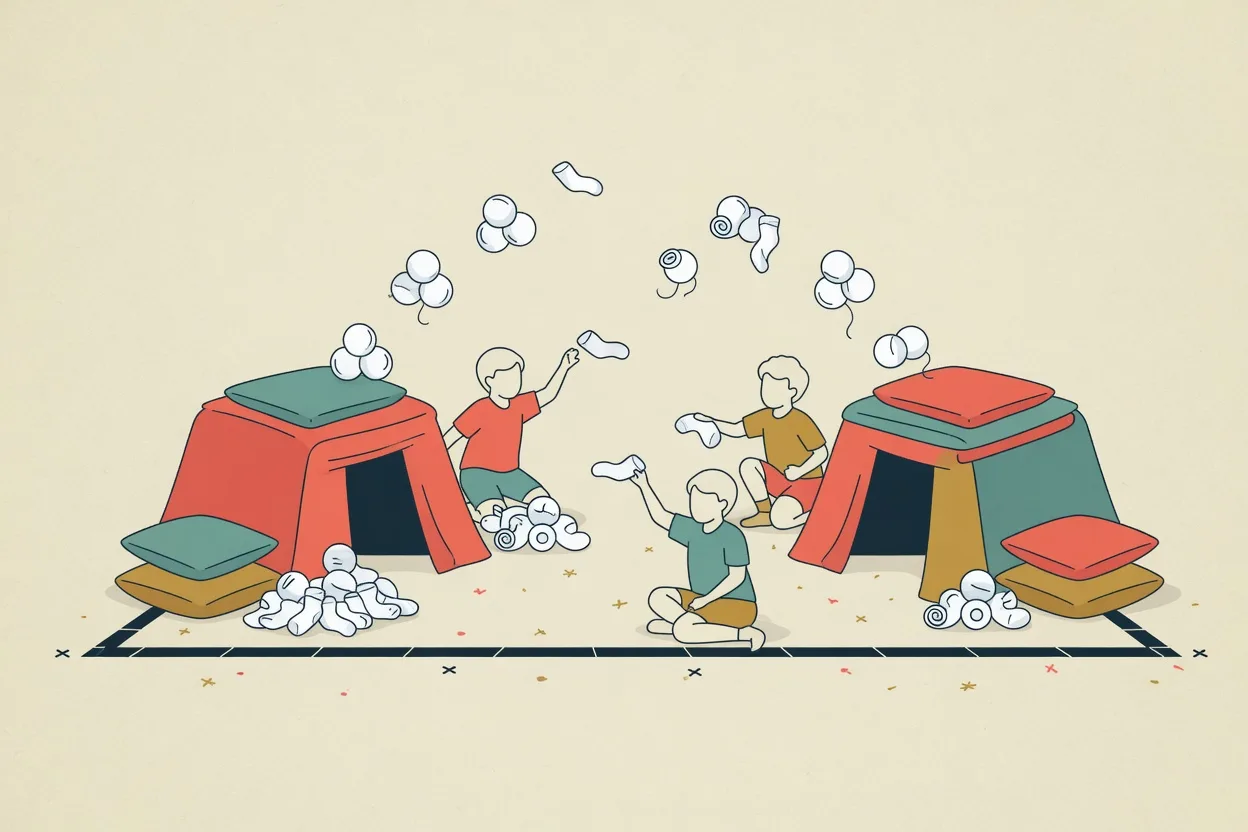
Rolled-up sock pairs are the best all-around choice — soft, a bit of weight to them so they throw properly, and no different from doing the laundry afterwards. Cotton balls are gentler again and a good choice for a younger or more sensitive group; scrunched newspaper taped shut sits somewhere in between. Whichever you use, make twenty to thirty per team beforehand — a fight with only ten snowballs a side is over in about four throws, which is not the game anyone was promised.
Forts are genuinely half the appeal, so give building them real time rather than treating it as setup to rush through. Sofa cushions, blankets over chair backs, and a coffee table turned on its side all make perfectly good cover, and letting the teams design their own fort for five minutes before the fight starts does more for engagement than almost anything else in this guide.
Warn any pets in the house before the first round starts, too — a sudden flurry of soft projectiles and shrieking children tends to send even a placid dog straight under the nearest bed, and it's kinder to shut them somewhere quiet in advance than to referee two fights at once.
The round structure, and where it goes wrong
Ninety seconds per round is close to ideal — long enough for a real exchange of fire, short enough that nobody's genuinely tired or bored by the end of it. Call "ceasefire" the instant the timer goes and mean it immediately, not after the current throw finishes; a fight that doesn't stop cleanly on the whistle is a fight that slowly loses the plot over successive rounds. The actual failure mode to watch for is aim drifting upward as the game gets more exciting — a below-the-shoulders rule needs to be said out loud before the first throw and genuinely enforced the first time it slips, not the third, because a soft sock is a fine hit to the chest and an unpleasant one to the face.
Soft ammunition does most of the safety work for you. The below-the-shoulders rule still has to be said out loud, and enforced the first time it slips.
Counting fallen snowballs on each side rather than tracking hits on a person is deliberately the fairer way to score a round — nobody has to agree on whether a particular throw actually landed, which is exactly the kind of dispute that can derail a game this fast-moving.
Run it before or after the calmer left right game, and if the group's still got energy to burn afterwards, send them out to find the last few hidden canes in the candy cane hunt.
What you need
- Soft "snowballs" — rolled sock pairs, scrunched paper, or cotton balls, twenty to thirty per team
- Sofa cushions and blankets, for forts
- A timer
- Two clear territories, marked by furniture or a taped line
How to play the indoor snowball fight
- Make your snowballs ahead of time — rolled-up sock pairs, scrunched sheets of newspaper taped shut, or a big bag of cotton balls all work; aim for twenty to thirty per team.
- Split the room into two territories with a piece of furniture, a taped line or a row of cushions as the border, and split the group into two teams, one per side.
- Build forts on each side from sofa cushions, blankets and chairs — give this five minutes of its own before the fight starts.
- Split the snowballs evenly between the two territories before the first round.
- Set a timer for ninety seconds and call "go" — teams throw snowballs at each other, never at heads or faces, and can dodge behind their fort.
- When the timer sounds, call "ceasefire" immediately, and count how many snowballs landed in each territory — fewer snowballs on your side means you won that round.
- Gather up all the snowballs, redistribute evenly, and run another ninety-second round.
Variations
One giant fort
Instead of two territories, build one large shared fort in the middle of the room and play "capture the fort" — whichever team holds the most ground inside it when time's called wins, which suits a smaller or mixed-age group better than a full two-sided battle.
Silent snowball fight
Play a round with no talking allowed at all — it sounds like a small change and turns out to be extremely funny, since half the fun of directing a team normally happens out loud.
Snowball target practice
Skip the fight altogether and line up cushions or laundry baskets as targets across the room, scoring points for hits — a good calmer warm-up before the real thing, or a stand-in for a group too young for a full two-sided fight.
Frequently asked questions
- What can you use as snowballs indoors?
- Rolled-up sock pairs, cotton balls, or sheets of newspaper scrunched into a ball and taped shut all work well and won't damage furniture or bruise on contact. Avoid anything with weight to it — a balled-up towel is more of a projectile than a snowball.
- How long should a round of indoor snowball fight last?
- Ninety seconds is about right — long enough for a real exchange, short enough that nobody's out of breath or out of ammunition. Run several rounds back to back rather than one long continuous fight.
- How do you stop an indoor snowball fight from getting too rough?
- Set the below-the-shoulders rule out loud before the first throw, and enforce it the first time it's broken rather than the third. Soft ammunition does most of the safety work for you, but the aim still matters.
- What age is an indoor snowball fight suitable for?
- From about four for the fort-building and gentle-toss version; the full two-team battle works best from around six or seven, once children can reliably aim below the shoulders and follow a stop signal.
Perfect for these parties
Themes that build a whole party around this game — with the food, the decor and a printable invite to match.