
6–12
Ages
6+
Players
Outdoors
Where
15–25 min
How long
Dodgeball at a birthday party is not school-gym dodgeball, and it shouldn't try to be — the version that works in a backyard uses foam balls, a forgiving court, and a couple of rules that keep it fair for a mixed-age, mixed-confidence group rather than the fastest, hardest throwers. Done right, it's genuinely one of the highest-energy games in this whole library, the kind that leaves everyone red-faced and grinning. Done with the wrong balls or no rules on where you're allowed to aim, it turns into the exact experience that makes some children dread the word dodgeball for years.
This covers ball choice, marking a real court in an ordinary backyard, the no-headshot rule that matters more than any other, and the catch-to-revive rule that keeps eliminated players in the game rather than sitting out for good.
Foam balls only, and marking a backyard court
Use soft foam balls, the kind sold for backyard play, and nothing else — no tennis balls, no rubber playground balls, nothing with any real weight or sting behind it. Foam balls hurt little enough that even a direct hit at close range is more surprising than painful, which is the entire difference between a fun backyard game and a genuinely miserable one. Four to six balls in play at once keeps the pace up without it turning into total chaos.
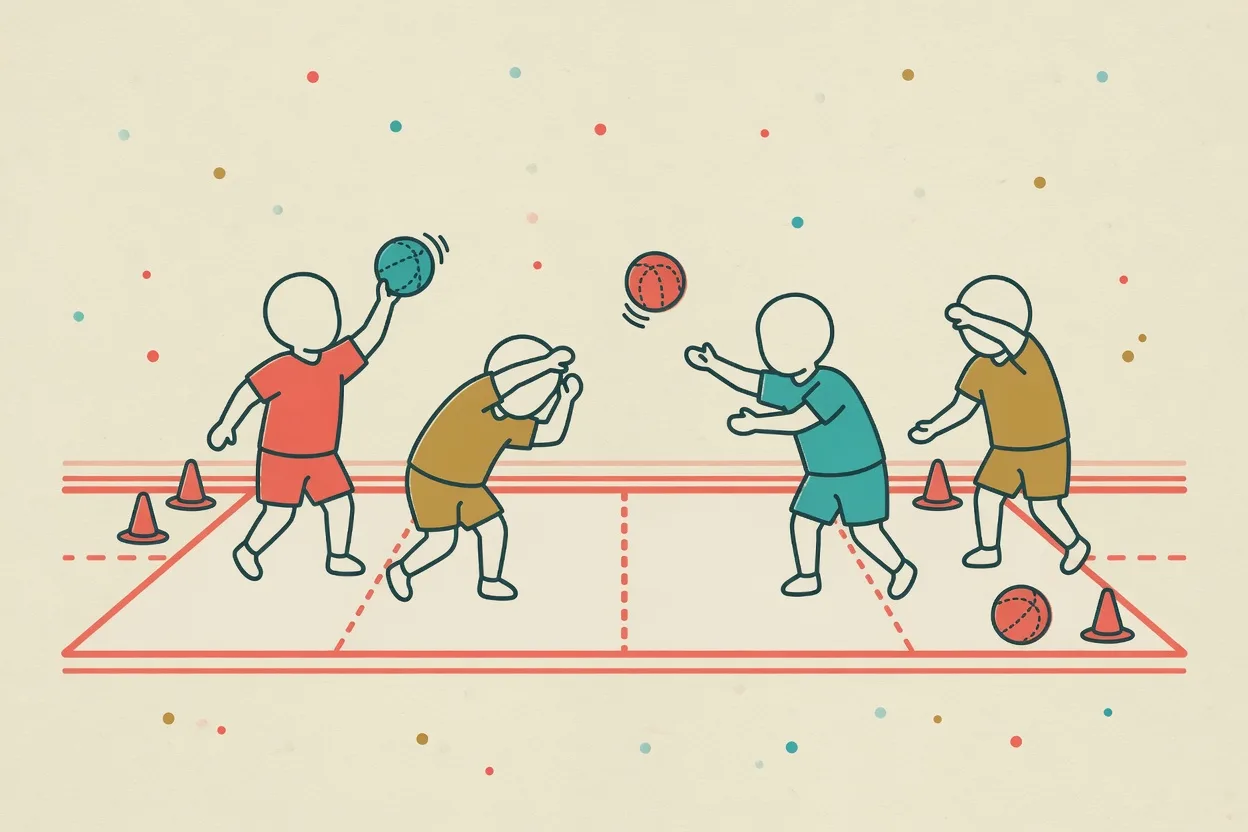
Mark a rectangular court with cones, chalk or a length of rope — roughly twenty by thirty feet works for eight to twelve players, smaller for fewer — with a center line splitting it into two halves. Anyone stepping outside the boundary is out, the same as being hit, which stops a chase spilling into the flowerbeds.
The rules that actually matter — and what goes wrong
Two rules do almost all the work of keeping this game safe and fair. No headshots, ever — a hit above the shoulders doesn't count and the thrower loses their turn with the ball, which trains children to aim at legs and bodies within the first couple of rounds. And catch to revive: if a player on the receiving end catches a thrown ball cleanly before it bounces, the thrower is out instead, and one eliminated player from that same team gets to rejoin the game. That second rule matters more than it sounds — it keeps eliminated children invested and watching for a chance back in, rather than sitting on the sidelines for the rest of the round.
The game usually goes wrong when one strong thrower dominates and everyone else spends the whole round just avoiding them rather than playing. Balance teams by size and age rather than headcount alone, and consider a rule that nobody can be targeted twice in a row by the same thrower, which spreads the game out. The other common failure is boundary disputes — a clear, visible line marked before the first throw settles far more arguments than a verbal about there ever will.
Steal the bacon is the other big outdoor dash game worth having ready — see steal the bacon for a calmer alternative between rounds of dodgeball.
What you need
- Soft foam balls, four to six — never anything harder
- Cones, chalk or rope to mark the court boundary and center line
- A patch of grass or another soft-ish surface, clear of obstacles
How to play dodgeball
- Mark a rectangular court roughly twenty by thirty feet with cones, chalk or rope, split by a center line into two halves.
- Split into two teams of matched size and age, one team on each half of the court.
- Put four to six soft foam balls into play, and let both teams throw them at players on the opposing side.
- A player is out if hit below the shoulders, if they catch and drop a thrown ball, or if they step outside the court boundary — headshots never count.
- If a player catches a thrown ball cleanly before it bounces, the thrower is out instead and one eliminated player from the catcher's team rejoins the game.
- Play continues until one team has no players left, then swap ends or reshuffle teams and start again.
Variations
Everyone's-a-target free-for-all (no teams)
Skip teams entirely and let everyone move freely within one larger space, out for the round once hit and back in when the round resets. Simpler to referee for a smaller or younger group, and needs no boundary line down the middle.
Gentle version (ages 4–6)
Drop the elimination entirely — nobody's ever out, hits just mean you sit down and count to five before rejoining. Keeps the underlying game while removing the part that upsets younger children: being out and having to wait.
King of the court
One player stands in the center as a target for both teams at once, protected by their own team forming a loose circle around them. Swap who's in the middle every couple of minutes. Popular with eight- to twelve-year-olds who enjoy the extra pressure of being singled out.
Frequently asked questions
- What balls should you use for kids' dodgeball?
- Soft foam balls made for backyard play, and nothing else — no tennis balls, no hard rubber playground balls. Foam stings little enough that a direct hit is more surprising than painful, which is the whole difference between a fun version and an unpleasant one.
- What is the no-headshot rule in dodgeball?
- A ball that hits a player above the shoulders doesn't count as an elimination, and the thrower loses their turn with the ball. It's the single most important rule for a kids' game and worth stating out loud before the first throw.
- How does the catch-to-revive rule work?
- If a player catches a thrown ball cleanly before it touches the ground, the thrower is out instead of the catcher, and one previously eliminated player from the catcher's team gets to rejoin the game. It keeps players who are out still invested in watching for their way back in.
- What age is dodgeball suitable for?
- From about six, once children can reliably follow rules about aiming and catching. Younger groups do better with the no-elimination version, where a hit just means sitting out for a five-second count rather than leaving the game.