
4–10
Ages
6+
Players
Outdoors
Where
10–20 min
How long
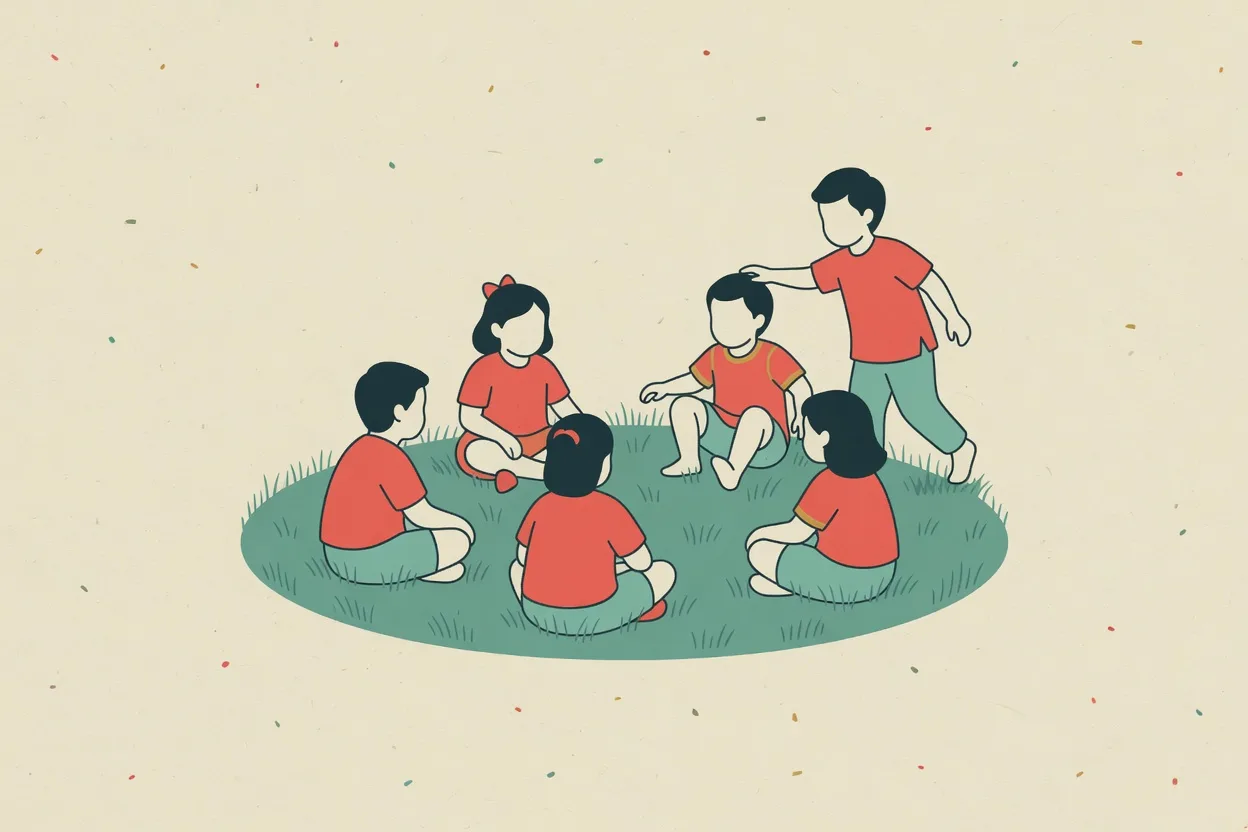
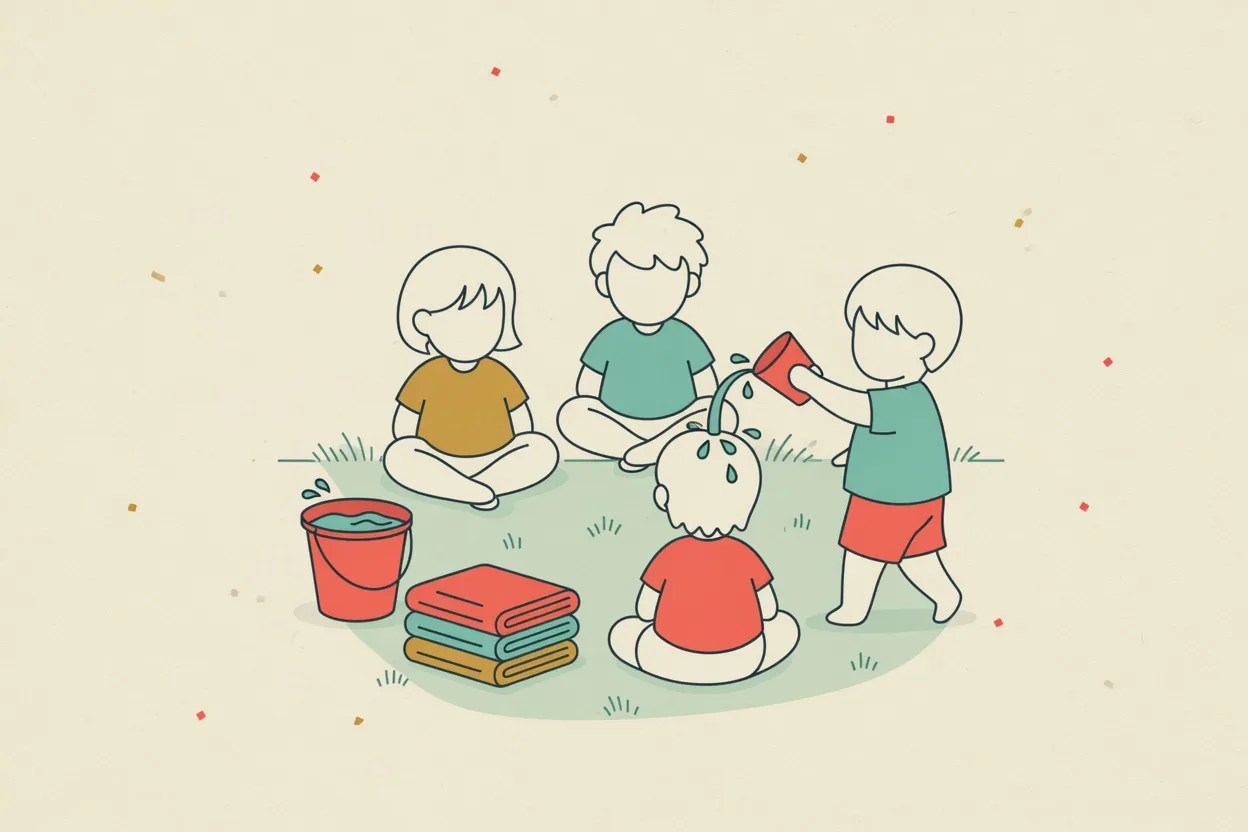
Drip drip drop is duck duck goose exactly as everyone already knows it, with one change: instead of tapping heads while saying "duck, duck, duck", the child going around the circle trickles a little water from a cup onto each head, and instead of "goose" the chosen child gets the cup properly upended over them before the chase starts. It needs no explanation for any child who's already played duck duck goose, it needs almost no equipment, and on a hot afternoon it's the version of the game everyone actually wants to play rather than the version they tolerate.
What follows covers how much water to actually put in the cup, the ages it suits, and the grass and towel logistics that stop a fun ten minutes turning into a slippery, cold-and-cranky one.
How much water, and where to play it
Fill the cup a third to halfway for the round-the-circle drips — enough to genuinely feel wet on each head, not so much that the cup is empty three children in. Save a full cup for the final "drop", which is the moment that gets the laugh and the chase started. Refill from a pitcher or bucket kept just outside the circle so the game doesn't stall while someone runs off to a faucet.
Play it on grass rather than concrete wherever you can. Wet grass is still reasonably grippy underfoot for a barefoot or sneaker-clad child running a lap of the circle; wet concrete or a wooden deck gets slick fast and is a genuinely worse surface for a game that ends in a sprint. If grass isn't an option, keep the running lap short and check the surface for slip risk between rounds rather than assuming it stays the same as it dries.
Use fresh, cold water from the faucet rather than water that's been sitting in a bucket in direct sun for an hour — on a genuinely hot day a lukewarm splash barely registers, which takes half the fun out of the game, while water straight from the faucet is enough to make every child on the circle sit up and pay attention when the carrier gets close. Top the bucket up from an indoor faucet partway through if it's warmed up noticeably.
Where it actually goes wrong
The problem is almost never the water itself; it's what happens to a soaked child in the ten minutes after their turn. A child who's just had a full cup poured over them and then run a lap needs a towel handed to them immediately, not fetched once they're already shivering — keep a stack within arm's reach of the circle from the first round, the same rule as bobbing for apples. The second thing that goes wrong is one particular child being picked as "drop" repeatedly by an over-eager water-carrier; rotate who holds the cup every two or three laps rather than leaving it with the same child the whole game.
Six is the practical minimum for a circle that still feels like a real chase, and it scales up easily to fifteen or more. If your line-up needs an outdoor game that isn't a chase, water balloon toss sits well right after this one, and the original dry version, duck duck goose, is worth having ready as a fallback if the weather turns while the party's still going.
What you need
- A plastic cup, filled with cold water for every lap of the circle
- A towel per child, within reach
- A patch of grass or a hard area that's fine to get wet
- A pitcher or bucket of extra water to keep the cup topped up
How to play drip drip drop
- Sit everyone in a circle facing inward, with plenty of space between the circle's edge and any furniture or hard obstacles.
- Fill a cup a third to halfway with cold water and hand it to one child, who walks around the outside of the circle.
- They trickle a small splash from the cup onto each head as they pass, saying "drip" each time.
- On any head, they can instead say "drop" and tip the rest of the cup fully over that child.
- The soaked child jumps up and chases the water-carrier once around the circle back to the gap they left.
- If the water-carrier is caught before reaching the gap, they refill the cup and go again; if they make it back safely, the soaked child takes the cup for the next round.
Variations
Sponge drop (ages 3–5)
Swap the cup for a wet sponge squeezed lightly over each head instead of poured water. It's gentler, easier for a small child to control without spilling everywhere, and less alarming for a child who isn't excited about a sudden faceful of cold water.
Ice cube drop
Drop a single ice cube down the back of the chosen child's collar instead of pouring water over their head — genuinely popular with eight- to ten-year-olds who find the classic version a bit tame by that age. Keep a small cooler of spare ice cubes next to the circle.
Frequently asked questions
- What do you need for drip drip drop?
- A cup of cold water, refilled between rounds, and a patch of grass or a surface that's fine to get wet. Towels within reach matter as much as the cup itself — line them up before the first round.
- How is drip drip drop different from duck duck goose?
- The rules are identical — walk the circle, tap or trickle water on each head, chase when caught out. The only change is a splash of water on "drip" and a full cup poured over the chosen child on "drop", instead of a hand tap and a shouted "goose".
- What age is drip drip drop suitable for?
- From about four and up, once a child is happy getting a bit wet and can manage a short chase around a circle. Younger children do better with the sponge version, which is gentler than a full cup poured over the head.
- How many children do you need for drip drip drop?
- Six is a reasonable minimum for a circle that still feels like a real chase, and it works well with fifteen or more. Any fewer and the lap around the circle becomes too short to be much of a race.