
3–8
Ages
3+
Players
Indoors or out
Where
5–15 min
How long
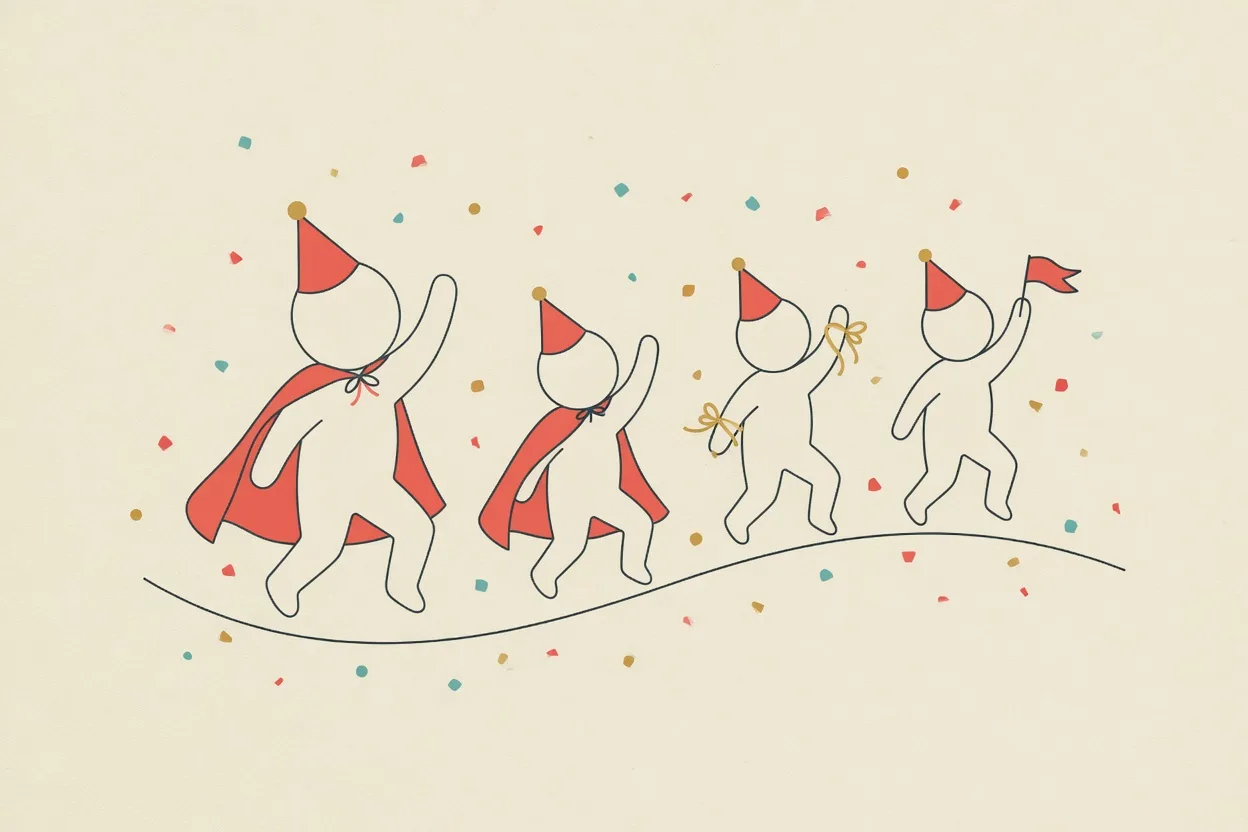
Follow the leader is the simplest game in this entire library: one child moves, everyone behind them copies exactly, and that's the whole rule set. It needs no equipment, no scoring and no explanation longer than a single sentence, which makes it the game to reach for when you have thirty seconds' notice and a hallway's worth of space. It also travels between indoors and outdoors without changing a single rule, which is unusual for a movement game.
Start with an adult leading the first lap. Children pick up the format instantly by copying a confident leader, and it means the first turn isn't spent on a child working out what they're supposed to be doing at the front of the line.
Why it falls apart, and how to stop that
Follow the leader has exactly one failure mode: the line breaks up. It usually starts small — one child at the back loses interest, wanders off to look at something else, and within thirty seconds the "line" is four separate children doing four separate things. The fix is pace and rotation, not discipline. Keep each leader's turn short — a minute, two at most — so nobody at the front runs out of ideas and nobody at the back has time to get bored. Swap the leader often, moving whoever's currently at the front to the very back of the line each time, so every child gets a turn near the front without anyone waiting through the whole line twice.
Giving the leader something to do
A leader who freezes and says "I don't know what to do now" is how a good round ends early. Give the first few leaders a starting idea rather than a blank page — walk like a robot, hop on one foot, tiptoe past the sleeping dragon by the sofa. Once one child has shown the group that silly and simple both count, the ideas that follow come without any more prompting needed. A running commentary from the adults at the side — "ooh, good one!" — does more to keep a shy leader confident than any amount of coaching beforehand.
Movement should stay small and controllable: marching, animal walks, funny faces and arm waves all copy well in a line; anything that needs space to build up speed, like running or big jumps, is better saved for outdoors where the leader can't clip a table on the turn.
Vary the pace deliberately, too — a few seconds of very slow, exaggerated movement followed by a burst of something quick resets everyone's attention and stops the line drifting into autopilot. It's a small trick, but it's the difference between a leader who holds the group for two full minutes and one who loses them after thirty seconds. Outdoors, a longer, looping route — around a tree, along a fence line, back through the middle — gives the leader more to work with than a straight line ever does, and it's a good way to use the whole yard rather than just the patch directly behind them.
For a version with more structure and a genuine catch built in, Simon says asks the same instant copying but adds a trap — only follow the instructions that start with the right two words.
What you need
- Nothing at all — just space to move and a leader with some ideas
How to play follow the leader
- Choose a leader to go first — an adult works best for the opening lap.
- Line everyone up behind the leader, close enough to see what they're doing.
- The leader moves around the space — walking, hopping, striking silly poses — and everyone copies exactly.
- Keep each leader's turn short, then move them to the back of the line and let the next child lead.
- Continue until every child who wants a turn at the front has had one.
Variations
Animal follow the leader
Each leader picks an animal to move like for their whole turn — waddle like a penguin, stomp like a dinosaur, slither like a snake. Gives shy leaders an instant idea instead of a blank page, and it's an easy way to fold in a party theme.
Obstacle course leader
Set out a few simple obstacles — around a chair, under a table, along a chalk line — for the leader to guide the group through. Works well from about six and up, once children can hold a sequence of moves in mind rather than just the last one.
Conga follow the leader
Everyone holds the shoulders of the child in front and moves as one long line rather than copying individually. Slower and sillier than the standard version, and a good way to physically herd a large group from one part of a yard to another.
Frequently asked questions
- What age is follow the leader good for?
- From about three, since the only skill needed is copying a movement, which even the youngest children at a party manage easily. It stays fun right up to about eight or nine as long as the movements get a bit more inventive.
- How do you stop follow the leader falling apart?
- Keep each leader's turn short — a minute or two — and rotate the leader often rather than letting one child hold the front for the whole game. A line that moves quickly holds together; one that drags loses children from the back within thirty seconds.
- Do quieter children get a turn leading?
- They should, and it's worth making a point of it — give every child in the line a turn at the front in order, rather than only picking confident volunteers. A shy leader often relaxes once they see that silly ideas are exactly what's wanted.
- Do you need any equipment for follow the leader?
- No — it's one of the few party games that needs absolutely nothing beyond a bit of open space. That makes it the easiest option when you need to fill five minutes with no notice at all.
Perfect for these parties
Themes that build a whole party around this game — with the food, the decor and a printable invite to match.