
4–10
Ages
3+
Players
Indoors or out
Where
5–15 min
How long
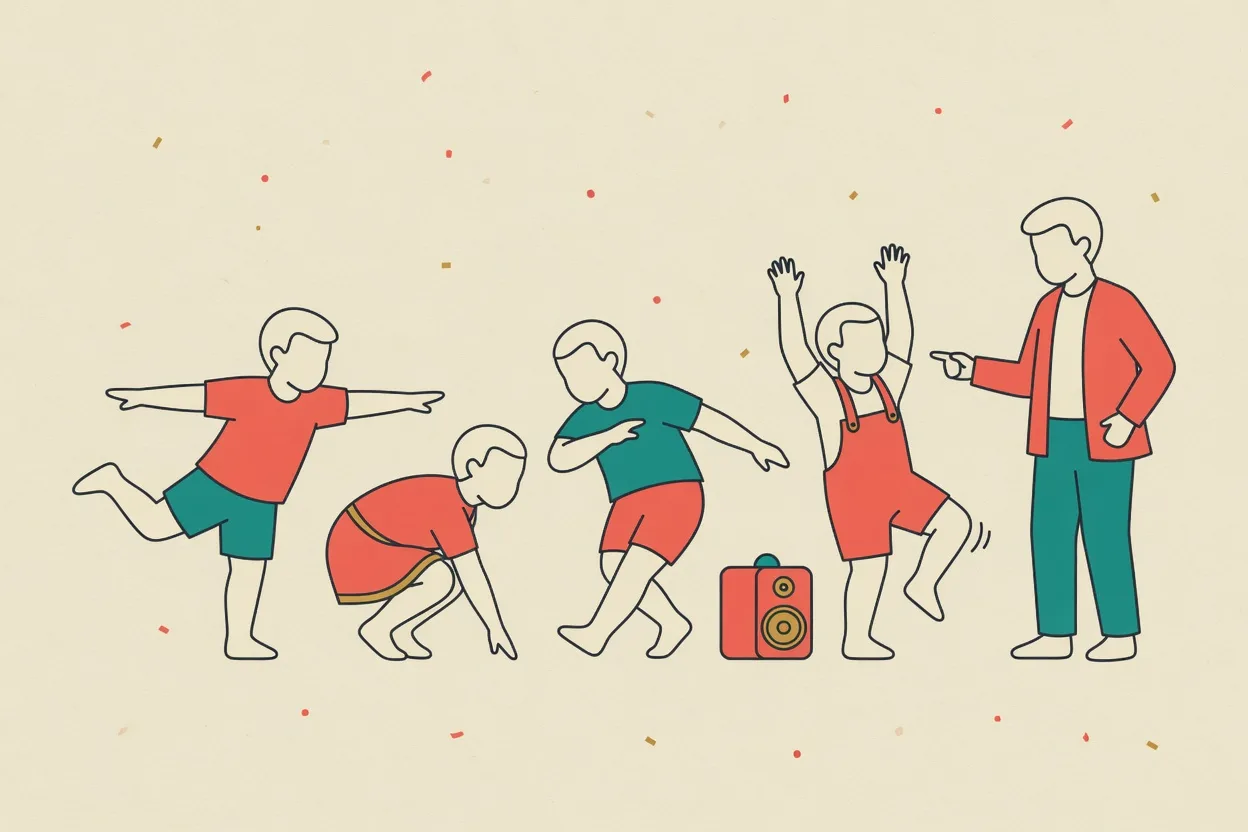
Simon says is entirely free, needs no space you don't already have, and is the single most reliable way to get a room of children to stand still and listen to an adult for five minutes. One person is Simon and calls out instructions; everyone follows, but only when the instruction starts with "Simon says". Leave those two words off, and anyone who still follows the instruction is out. That's the whole game — the skill is entirely in how well you call it.
Start with an adult as Simon for the first round or two. Children copy the pacing and the trickery far faster from watching a well-run round than from being told the rules, and it means the first Simon isn't a child guessing at how to do the job.
How to call Simon says well
A flat, predictable Simon is a boring one. Build a rhythm of straightforward calls — "Simon says touch your toes", "Simon says spin around" — then drop in a trap without changing your tone at all: "jump up", said in exactly the same voice as everything before it. The catch only works if it sounds identical to a real instruction; a Simon who slows down or grins before a trick call gives it away before anyone's had a chance to fall for it. Mix in fast bursts of three or four real "Simon says" calls in a row to get everyone moving quickly, then drop the trap into that rhythm — that's where most children actually get caught.
The other common failure is speed: a Simon who pauses to think between calls loses the room's attention within a minute. Decide your next three instructions before you start speaking, so the calls come out quick enough that hesitation never becomes the tell that lets everyone spot a trap in advance.
The best instructions are physical and quick to check — touch your nose, hop twice, spin around — rather than anything that takes explaining or leaves room for argument about whether it was done correctly. Save the genuinely silly instructions, like walking like a crab or pulling a funny face, for mid-round rather than the opening calls; children need a few straightforward repetitions to settle into the rhythm before the calls get more inventive.
Elimination or not
This is the decision that decides whether the game holds up for your actual age range. Classic elimination — out means out, sit down and watch — works fine from about seven upwards, where being out for the last few minutes of a ten-minute game doesn't sting much. Under that age, being out early and often is genuinely the thing that ruins Simon says: a four-year-old caught in round two has nothing to do for the rest of the game and usually says so, loudly. Swap to a no-elimination version instead — a silly forfeit like one jumping jack — and the youngest child in the room stays exactly as involved as the oldest.
If your group has already worn out Simon says, follow the leader keeps the same instant-obedience energy but swaps the trickery for straightforward copying, which suits an even younger crowd.
What you need
- Nothing at all — just a leader who can call instructions with a straight face
- Enough open floor for everyone to move without bumping into each other
How to play Simon says
- Choose one player to be Simon — an adult is the best choice for the very first round.
- Simon calls out an instruction. If it starts with the words "Simon says", everyone follows it.
- If Simon gives an instruction without saying "Simon says" first, anyone who follows it anyway is out.
- Simon keeps calling, mixing genuine "Simon says" instructions with occasional trick calls, gradually speeding up.
- In the elimination version, the last player still in becomes Simon for the next round. In the no-elimination version, anyone caught does a small forfeit and keeps playing.
Variations
No-elimination forfeits (ages 3–6)
Instead of sitting out, anyone caught doing an instruction without "Simon says" does one small forfeit — a jumping jack, a silly noise, a spin in place — and stays in the game. Keeps the youngest children involved for the whole round instead of watching from the sidelines.
Team Simon
Split into two teams and have each team's last-standing player face off as a final round. Gives a big group something to cheer for beyond their own turn, and it halves how long any one child waits to be caught or crowned.
Speed round
For children who already know the game well, drop the trick calls entirely for thirty seconds and just call real instructions as fast as you can speak. It's a different kind of challenge — keeping up — and a good way to burn off the last of the energy before cake.
Frequently asked questions
- How do you call Simon says well?
- Keep every instruction in exactly the same tone of voice, whether it's a real "Simon says" call or a trick, and decide your next few instructions before you start speaking so there's no hesitation to give the trap away. Mixing in quick bursts of real calls before dropping a trick catches the most people.
- What age is Simon says good for?
- From about four, with the elimination rule switched off for the youngest players. Full elimination — out means out, sit and watch — suits about seven and up, where a child caught early doesn't mind waiting out the rest of a short game.
- What happens when a child is caught?
- In the classic version, they sit down and watch the rest of the round. Most groups under about six do better with a no-elimination version instead, where being caught means a small forfeit rather than leaving the game.
- Can Simon says be played without eliminating anyone?
- Yes, and for younger children it's the better version. Swap elimination for a small forfeit — a jumping jack, a silly noise — so every child is still playing when the round ends, not watching from the side.
Perfect for these parties
Themes that build a whole party around this game — with the food, the decor and a printable invite to match.