
5–11
Ages
4+
Players
Outdoors
Where
10–20 min
How long
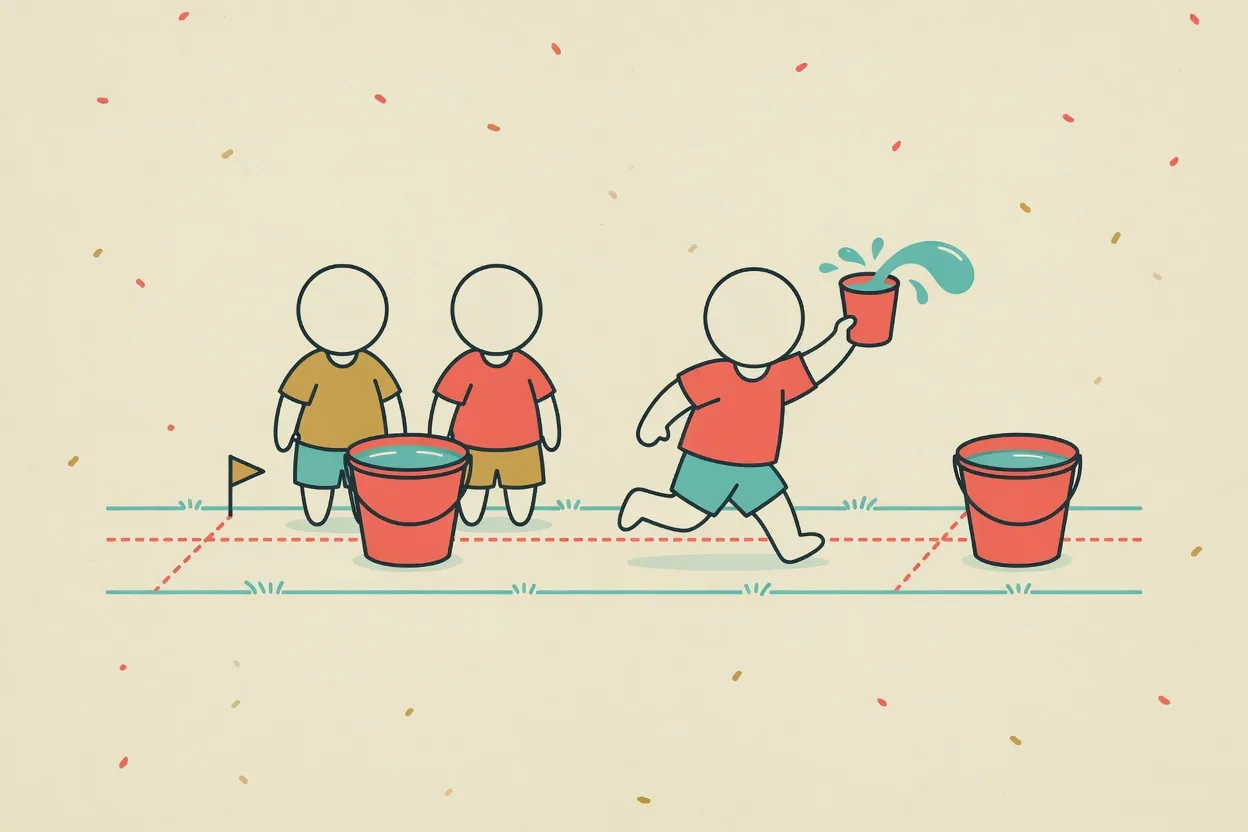
Water cup relay is a straightforward idea that turns out to be genuinely fun to watch as well as play: each runner scoops a small cup of water from a full bucket at the start, carries it — overhead, or through a cup with holes punched in the bottom — to an empty bucket at the finish, pours in whatever's left, and races back to hand the cup to the next teammate. The team whose bucket has the most water in it after everyone's had a turn wins, and on a warm afternoon a good bit of that water ends up on the runners themselves, which is exactly the point.
What follows covers the bucket math, the cup choice that decides how the game actually plays, and the towel and clothing planning that keeps this from turning your yard into more of a swamp than intended.
Buckets, cups and the lane
Two buckets per team is the setup: a full one at the start line, holding roughly a third of a standard mop bucket's worth of water, and an empty one at the finish, 20 to 25 feet away. Any less distance and the game's over in seconds; much more and small children spend most of the round just walking. Mark the lane with cones or chalk so teams don't drift into each other mid-run.
The cup you choose sets the whole tone of the game. A plain solid cup carried carefully spills relatively little, which suits younger children who'd otherwise get frustrated watching their whole effort disappear before the finish line. Punch three or four small holes in the bottom of the cup instead, and the game becomes a genuine race against a steadily draining cup — better for seven- to ten-year-olds who find the plain version too easy. Decide which version you're running before you hand out cups, not halfway through.
Where it goes wrong
The mistake most hosts make is treating this as a straightforward running relay and forgetting that a wet lane gets genuinely slippery within a couple of rounds, especially on concrete or a deck. Play on grass if you have it, and if you don't, stop every few minutes to check the ground underfoot rather than assuming it's the same as when you started. The second thing that trips people up is towels — or the lack of them. A cup of water carried at a run reliably ends up down a child's front as much as in the bucket, and a soaked, cold child standing around waiting for their next turn is the fastest way to end this game early. Towels by the start line, from round one.
Four is the minimum for two real teams of two, though it scales comfortably to a dozen or more with longer teams. For a game that swaps the running for a chase instead, drip drip drop uses the same bucket and cup, and if you'd rather skip the water and keep the running, a straight sponge relay or a dry relay race both fit the same slot.
What you need
- Two buckets per team — one full of water at the start line, one empty at the finish
- One small cup per child, ideally with a few holes punched in the side or held overhead
- A finish line marker for the target bucket
- Plenty of towels, and a change of clothes on standby
How to play water cup relay
- Split into teams of two or more and give each team a full bucket at the start line and an empty bucket 20 to 25 feet away at the finish.
- Give the first runner a small cup — plain, or with holes punched in the bottom for a faster-draining version.
- On "go", they scoop a cupful from the full bucket and run to pour whatever's left into the empty bucket at the finish.
- They run back and hand the cup to the next teammate, who repeats the scoop-and-carry.
- Keep going until every player on the team has had a turn.
- The team with the most water in their finish bucket at the end wins; measure with a second cup if it's close.
Variations
Sponge scoop (ages 3–5)
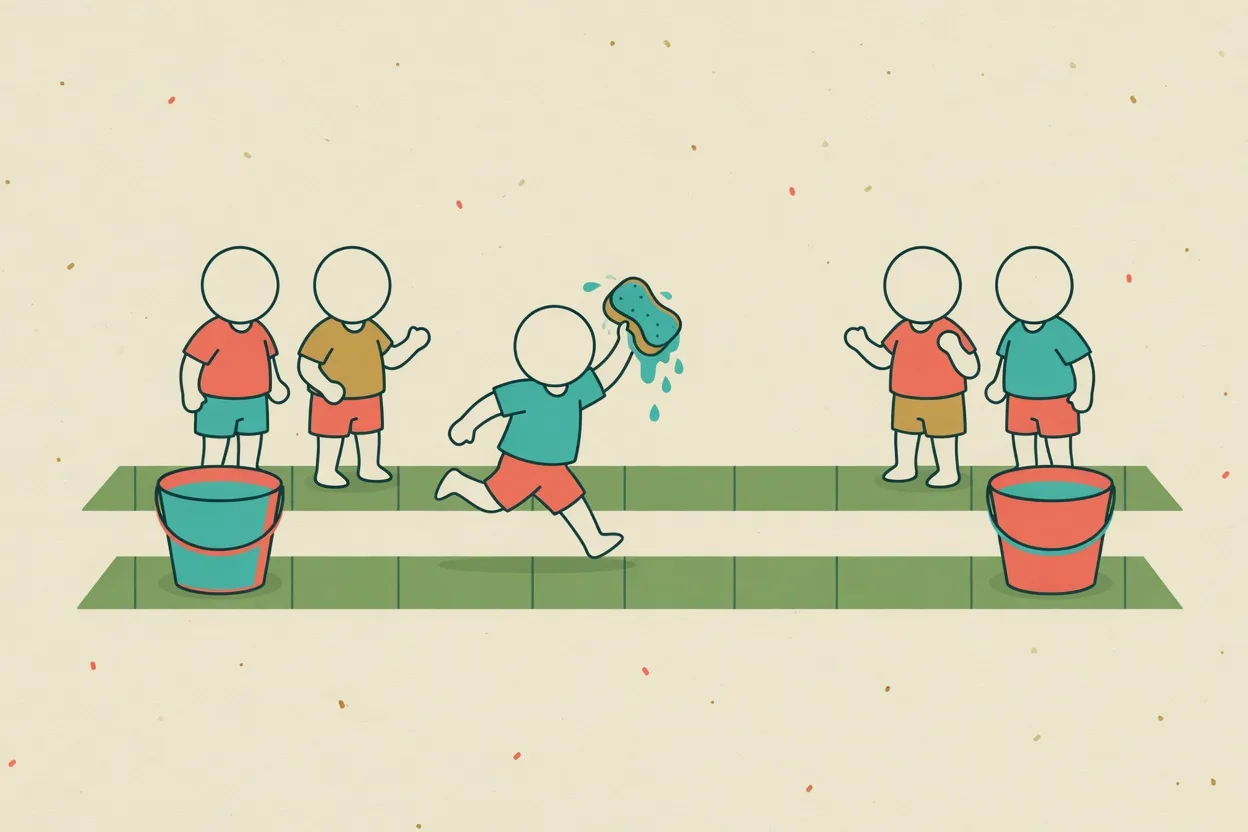
Swap the cup for a sponge that gets dipped and squeezed out over the finish bucket instead of carried overhead. It's slower and far less prone to a total spill, which suits younger children who want to actually see water land in the bucket rather than mostly on the grass.
Overhead pass
Instead of running the cup down the lane, line the whole team up and pass a filled cup hand to hand overhead from the first player to the last, who pours it into the bucket. No running at all, which works well for a smaller yard or a group that's already tired from earlier games.
Frequently asked questions
- What do you need for water cup relay?
- Two buckets per team — one full, one empty — a small cup per runner, and a lane of 20 to 25 feet between them. Towels count as essential gear here, not an afterthought.
- Should the cup have holes in it?
- Either works. A solid cup suits younger children, who'll otherwise get frustrated at how much spills before they reach the bucket. A cup with a few holes punched in the bottom turns it into a real race against a draining cup, which older children tend to prefer.
- What age is water cup relay suitable for?
- From about five up. Under that, the sponge-scoop variation works better — it's slower and much more forgiving of an unsteady walk than a full-speed cup relay.
- How do you keep water cup relay from making a mess of the yard?
- Play on grass rather than concrete or a deck wherever you can, since a wet hard surface gets slippery fast. A shorter lane also means less water lost mid-run, if keeping things tidy matters more than the race itself.