

5–11
Ages
6+
Players
Outdoors
Where
10–15 min
How long
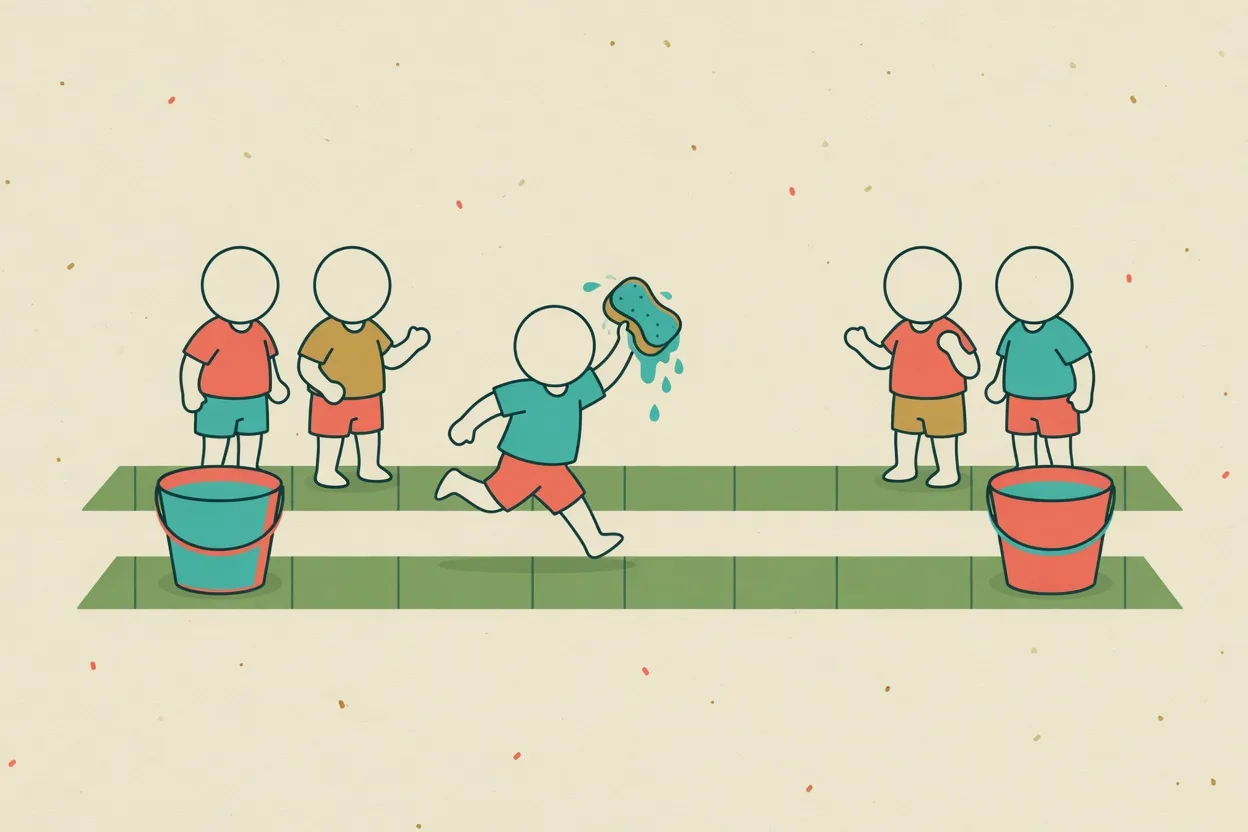
The sponge relay is a bucket-brigade in miniature: run to a full bucket, soak a sponge, run back, squeeze it into an empty one, hand off to the next player. It looks almost too simple to explain, and it is — the entire game is in getting the math right so a round takes five satisfying minutes rather than dragging on for twenty.
Here's how much water a sponge actually moves, the fill line that keeps a round the right length, and the team sizes that stop children spending most of the game standing in line.
The bucket math that actually matters
A standard soaked bath sponge holds somewhere around 3 to 5 ounces of water, and loses a fair bit of that on the run back whatever anyone does — some drips, some gets squeezed too early, some just evaporates off in the sun. That means filling a full five-quart bucket by sponge alone could take forty, fifty, sixty trips per team, which is far too long for a relay game to hold anyone's attention. Mark a fill line a third or even a quarter of the way up the empty bucket instead, in tape or marker, and that's your actual finish line. It sounds like giving up early; it's really just designing a game that finishes while everyone's still enjoying it.
Keep a measuring cup by the finish buckets if anyone's likely to argue the result — holding both buckets up to the light usually settles it, but a measuring cup settles it faster and with a number nobody can dispute.
Mark the fill line a third of the way up the bucket, not the top. That's not giving up early — that's designing a game that finishes while everyone's still enjoying it.
Team sizes and where it goes wrong
Four to eight players per team is the range that works. Fewer than four and one quick child can effectively win the relay alone, which isn't much of a team game; more than eight and most children spend the whole round standing in a line watching, which is where a promising game quietly loses its audience. The other place this goes wrong is the run itself — wet grass is genuinely slippery, and a relay by definition has children running the same short strip of lawn over and over. Ask for a jog rather than a sprint on the way back specifically, since that's the leg where a dripping sponge and tired legs combine to actually cause a fall.
It's also one of the few games here that genuinely doesn't care about skill or size — a small, careful five-year-old carrying a slow, steady sponge can keep pace with a sprinting ten-year-old who keeps losing half the water on the way, which is a nice leveler for a mixed-age group.
Run it alongside water balloon toss for a hot-weather double feature, and check the tug of war guide too if the same group wants one more outdoor team game before the afternoon's out.
What you need
- Two large sponges, one per team
- Two full buckets of water, as the start points
- Two empty buckets, marked with a fill line partway up
- A measuring cup, for a fair fill line and settling close finishes
- A stretch of lawn, twenty-five to thirty feet, to run down
How to play the sponge relay
- Mark two identical lanes on the grass, each with a full bucket of water at the start and an empty bucket at the far end, about twenty-five to thirty feet apart.
- Mark a fill line partway up each empty bucket in tape or marker — a third full is plenty; filling a whole bucket by sponge alone takes far longer than the average attention span.
- Split into two even teams and line them up behind the full buckets.
- On "go", the first player dunks the sponge in the full bucket, runs to the empty bucket, squeezes out every drop they can, and runs back to hand the sponge to the next teammate.
- Keep going, player after player, until one team's empty bucket reaches the fill line.
- Check the water level together rather than eyeballing it from a distance — close finishes are genuinely close, and a bucket held up to the light settles most arguments.
Variations
Relay by pairs
Run it two at a time instead of one — one child carries the sponge, the other steadies the bucket at the far end and hands it straight back. Good for a bigger group where standing in a long line would otherwise kill the pace.
Head-carry version (ages 8+)
Older children balance the soaked sponge on their head rather than carrying it by hand, hands clasped behind their back, for a much slower and much funnier round.
Timed transfer
Skip the race entirely and just see which team can transfer the most water in ninety seconds, checked with a measuring cup at the end — better for mixed-age teams where a straight footrace would be one-sided.
Frequently asked questions
- How much water does a sponge relay actually move?
- A standard bath sponge holds roughly 3 to 5 ounces when fully soaked, and loses some on the run whatever you do, so filling even a third of a five-quart bucket takes forty or fifty good trips. Mark a lower fill line than you'd think to keep the game to a sensible length.
- How many players should be on each sponge relay team?
- Four to eight works best. Fewer than four and one fast child can carry the whole team; more than eight and players spend most of the game standing in line waiting for their turn.
- Do you need two sponges or one?
- Two, one per team, so both sides run at the same time rather than taking turns. A spare sponge per team is worth having too, since a dropped sponge on grass tends to pick up mud and grit.
- What age is the sponge relay suitable for?
- From about five, once a child can run a short distance carrying something without adult supervision at their elbow. Kids under five enjoy it just as much walking rather than running, so relax the pace rather than the rules for the youngest players.