
4–9
Ages
4–15
Players
Indoors or out
Where
10–20 min
How long
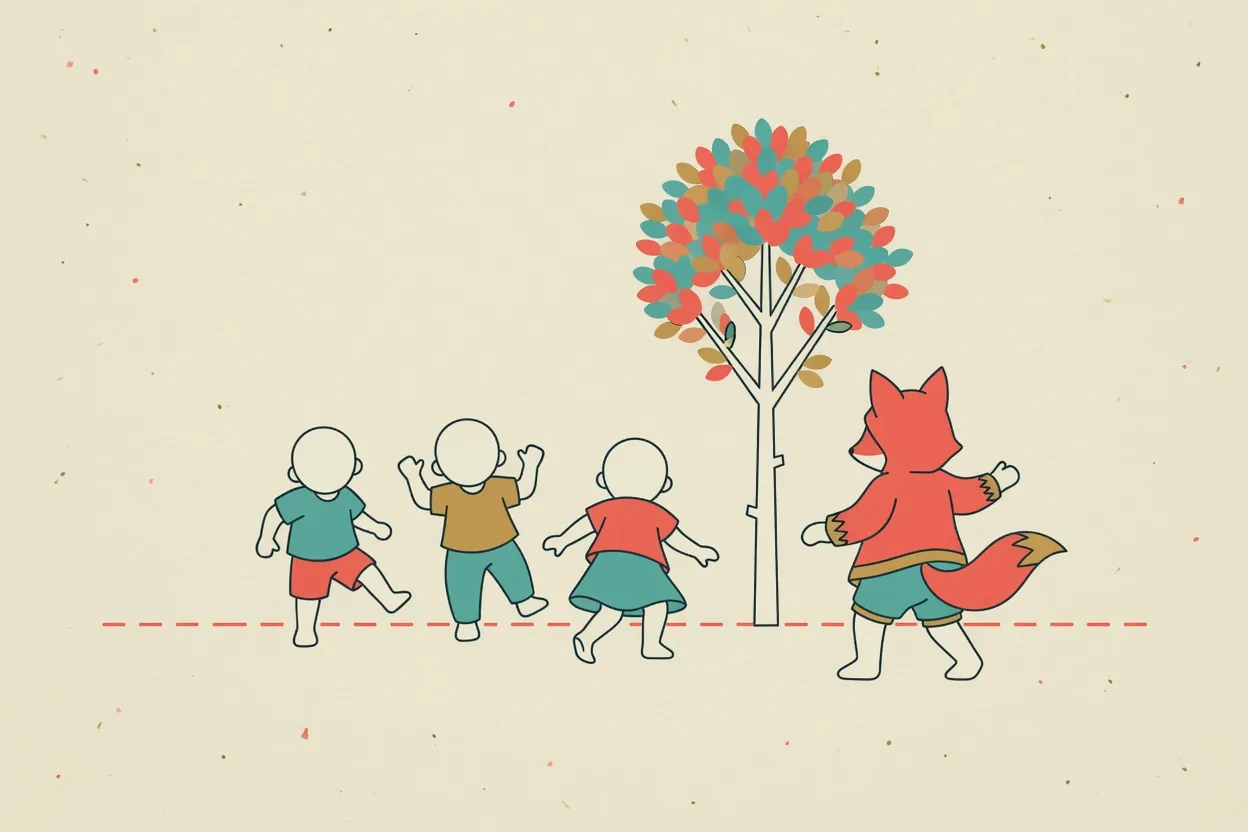
What's the time, Mr. Fox — known to plenty of American kids as "what time is it, Mr. Fox?" — turns a simple question into ten minutes of held breath. One player is the fox and stands facing away from everyone else; the group creeps closer with every honest answer, and scatters the instant the fox stops answering honestly. It needs nothing but a wall for the fox to face and open ground to creep across, and the tension it builds with absolutely no props is hard to match.
The "clock" part of the name is the whole mechanic: the group calls out "what's the time, Mr. Fox?", the fox answers with any hour — "three o'clock" — and everyone takes that many steps forward. Call it again, get a new hour, take that many more steps. The fox can answer honestly for as long as they like, which is exactly what makes the ending unpredictable.
The calling cadence that builds suspense
A fox who answers the same way every time — always a big number, or always a small one — gets worked out within two rounds, and the game stops being tense. Vary it: a one o'clock that lets everyone take a single cautious step keeps them close and nervous; a nine o'clock a few calls later closes the gap fast and catches people off guard. The best foxes let the group get uncomfortably close before doing anything, because the anticipation of not knowing when "dinner time" is coming is the entire game — shouting it on the very first call is technically allowed and makes for one very short, unsatisfying round.
Older children quickly work out that counting the fox's answers gives them a rough sense of how close they've crept, which adds a small layer of mental arithmetic to the physical game without anyone noticing they're doing math. It's part of why the game holds up well right through the elementary-school years, long after some of the simpler circle games have stopped being enough of a challenge.
Managing the dinner-time chaos
This is where it goes wrong if nobody's thought about it in advance: at any point, instead of a number, the fox shouts "dinner time!" and spins around to chase everyone back to the start line, and the sudden switch from a slow creep to a full sprint in a crowded space is exactly the moment collisions happen. Set the starting line further from the fox than feels necessary — the extra distance gives faster and slower children room to spread out rather than bunching at the fox's heels — and walk the run-back path yourself first to clear anything a child sprinting backwards-facing-forwards wouldn't see coming. Whoever the fox catches becomes the fox for the next round; if nobody's caught, the fox goes again.
It sits well alongside duck duck goose as a pair of chase games that both rely on one player springing a surprise on everyone else, and swapping between the two keeps a backyard full of children entertained for a good half hour.
Let a few different children take a turn as the fox across the party rather than always picking whoever gets caught. Some children love the sudden power of shouting "dinner time"; others find standing with their back to a crowd genuinely nerve-wracking, so it's worth keeping an eye on who actually wants a turn rather than assuming everyone does.
What you need
- A wall, tree or fence for the fox to stand against
- Open ground between the fox and the starting line for the creep and the chase
- Nothing else — no equipment needed
How to play what's the time, Mr. Fox
- Choose one player to be the fox. They stand facing a wall, tree or fence, with their back to everyone else.
- Line everyone else up at a starting line some distance away.
- The group calls out together, "What's the time, Mr. Fox?" and the fox answers with any hour, such as "three o'clock".
- Everyone takes that many steps forward, then calls the question again for a new answer.
- At any point, instead of a number, the fox can shout "Dinner time!", turn around, and chase everyone back to the start line.
- Whoever the fox catches becomes the fox for the next round. If nobody is caught, the same fox plays again.
Variations
Shorter chase (ages 4–5)
Halve the distance between the fox and the starting line, and have the fox call "dinner time" within the first few rounds rather than drawing out the suspense. Younger children lose interest in a long, slow creep, and a shorter chase keeps the game inside their attention span.
Sleeping fox
The fox crouches down and pretends to sleep instead of standing with their back turned. Everyone creeps up to touch the fox's shoulder before they wake and chase — a gentler build-up with no calling or counting needed, good for children not yet confident with the question-and-answer version.
Indoors, in a gym
Play the same rules across a gym or large room, with the fox facing a wall at one end. Works just as well without grass, as long as the run-back path is clear and the floor isn't slippery underfoot.
Frequently asked questions
- How do you play What Time Is It, Mr. Fox?
- One player, the fox, stands facing a wall while everyone else lines up at a distance and calls, "What's the time, Mr. Fox?" The fox answers with an hour, such as "three o'clock," and everyone takes that many steps forward, until the fox shouts "Dinner time!" instead, turns and chases everyone back to the start; whoever is caught becomes the next fox.
- What age is what's the time, Mr. Fox good for?
- From about four, with a shorter creeping distance and an earlier "dinner time" call for the youngest players. From about six, children enjoy the fox drawing out the suspense with small, cautious hours before finally springing the chase, and the game holds up right through the elementary-school years.
- What happens when the fox shouts dinner time?
- The fox turns around and chases everyone back to the starting line. Whoever gets caught becomes the fox for the next round; if the fox catches nobody, they simply play the fox again. The call can come at any point instead of an hour, which is what keeps everyone nervous.
- How far away should the starting line be?
- Further than feels necessary — extra distance gives children room to spread out during the sudden chase rather than bunching up right behind the fox. A backyard's full length or a school gym's width both work well; for four- and five-year-olds, halve the distance and call "dinner time" sooner.
- Can you play it indoors?
- Yes, as long as there's a wall for the fox to face and a clear run-back path with nothing to trip over. A gym or a large playroom works just as well as a backyard, provided the floor isn't slippery underfoot.