
3–10
Ages
3+
Players
Indoors or out
Where
15–30 min
How long
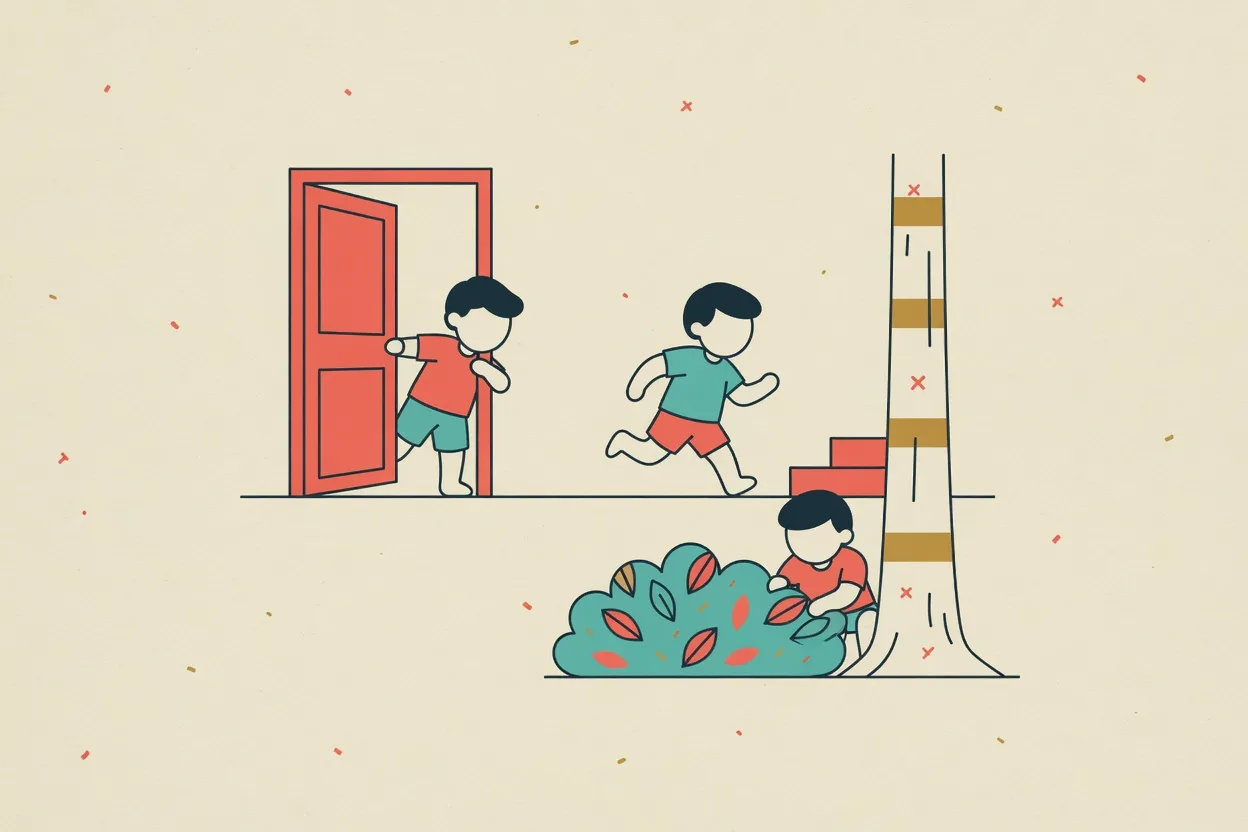
Hide and seek is the one game on this list nobody has to be taught. Every child already knows the shape of it — someone counts, everyone else disappears, someone gets found — which is exactly why it never gets written down properly, and why almost every family plays it with slightly different rules. Whose job is home base? What actually counts as being caught? Is climbing over the backyard fence to hide fair game? None of that is obvious until someone asks, usually mid-argument.
This guide sets out the version that avoids most of those arguments — a real home base, a boundary that gets said out loud, and a fair way to end a round when somebody's hiding spot turns out to be unbeatable.
Boundaries and home base — the two things families never actually agree on
Home base needs to be one specific, touchable thing, not a general area — "the porch" invites an argument about which part of the porch; "this step" does not. Point to it and say so before the first round, and pick somewhere a seeker can genuinely stand with their eyes shut without getting a clear view of the yard. The boundary matters just as much and gets skipped far more often: walk the edge of where hiding is allowed with the whole group once, out loud, before anyone scatters. Without it, the game quietly expands into the neighbor's yard, behind parked cars, or — with younger children especially — somewhere nobody thought to check. For the very youngest players, walk the boundary again partway through the afternoon as a reminder — a three-year-old who agreed to it five minutes ago has usually forgotten by the time they are actually hiding.
How long the seeker counts matters more than most families think. Too short and small children haven't found a spot yet; too long and older ones get bored waiting to be found. Twenty is about right for a single room, thirty for a whole house, and up to fifty for a backyard with real hiding spots — adjust down for a younger group, since a long count with nothing to do is where a seeker starts peeking.
Ending a round without an argument
Two things decide a fair finish. First, a hidden player is allowed to make a run for home base at any point rather than waiting to be found — if they touch it before the seeker spots them, they are safely in, and racing the seeker there is genuinely half the fun of the game. Second, not every hiding spot gets found, and that is fine: when a spot is clearly unbeatable or everyone is bored of waiting, call "olly olly oxen free" (or whatever version your family already uses) to bring the last hiders in without it counting against them. Trying to force a result out of a round that has quietly stalled is what turns a good game sour.
For the reverse version of this exact game, see sardines — one hides, everyone else looks. Or keep the same boundary rules and switch to a chase with freeze tag. Browse local entertainers if you would rather someone else did the counting.
What you need
- A home base everyone can see and agree on — a tree, a doorstep, a particular chair
- Clear boundaries for where hiding is and isn't allowed, set before the first round
- Nothing else — hide and seek is one of the very few games that needs no equipment at all
How to play hide and seek
- Agree on a home base — a tree, a porch step, a particular chair — and agree on the boundary of where players may hide, out loud, before the first round.
- Choose a seeker. Everyone else scatters to hide while the seeker closes their eyes at home base and counts to an agreed number.
- The seeker calls "ready or not, here I come" and goes to look, leaving home base unguarded.
- Hidden players may leave their spot at any point and make a dash for home base. If they touch it before the seeker sees them, they are safely home and out of the round.
- When the seeker spots a hidden player, they call the player's name and location and race them both to home base — whoever touches it first decides who is "found".
- The round ends when every player is either found or safely home. If anyone is still hiding once the others are done, call "olly olly oxen free" to bring them in without penalty.
- The first player found becomes the next seeker, or the seeker chooses who goes next for a bigger group.
Variations
Indoors
Limit the boundary to a small number of rooms rather than the whole house, and clear anything breakable out of reach before you start. Keep the count shorter indoors — a smaller space needs less time to hide in, and a fifty-count in a three-bedroom house just means a long wait for a very findable spot.
Backyard or park version
Outdoors gives you far more genuine hiding spots — behind a shed, inside a hedge, around the side of a car — and a bigger boundary to enforce clearly. Walk it with the whole group once before the first round so every child, not just the oldest ones, actually knows where the edge is.
Team hide and seek
Split into two teams: one hides together in pairs or small huddles rather than alone, and the seeking team has to find every member of a group before that group is fully out. Slower and more social than the solo version, and a good fit for a child who finds hiding alone for several minutes a bit much.
Frequently asked questions
- What does "olly olly oxen free" mean in hide and seek?
- It's the traditional call that ends a round and brings in anyone still hiding, without them being caught or penalized — useful when a hiding spot is simply too good, or it's time to move on to the next game. Families use plenty of different versions of the phrase; the words matter less than everyone agreeing what it means.
- How long should the seeker count in hide and seek?
- Twenty is about right for a single room, thirty for a whole house, and up to fifty for a backyard with real hiding spots. Shorten it for a younger group — a long count with nothing to do is when a seeker starts peeking.
- What makes a good home base for hide and seek?
- Something fixed, specific and visible to everyone — a particular tree, step or chair, agreed and pointed out before the first round starts. A vague area like "the porch" invites an argument about exactly where it ends.
- What age is hide and seek suitable for?
- From about three with an adult nearby to remind them where home base is, and properly independent from about five. Younger children need a much smaller boundary than older ones.
Perfect for these parties
Themes that build a whole party around this game — with the food, the decor and a printable invite to match.