
4–10
Ages
3+
Players
Indoors
Where
10–20 min
How long
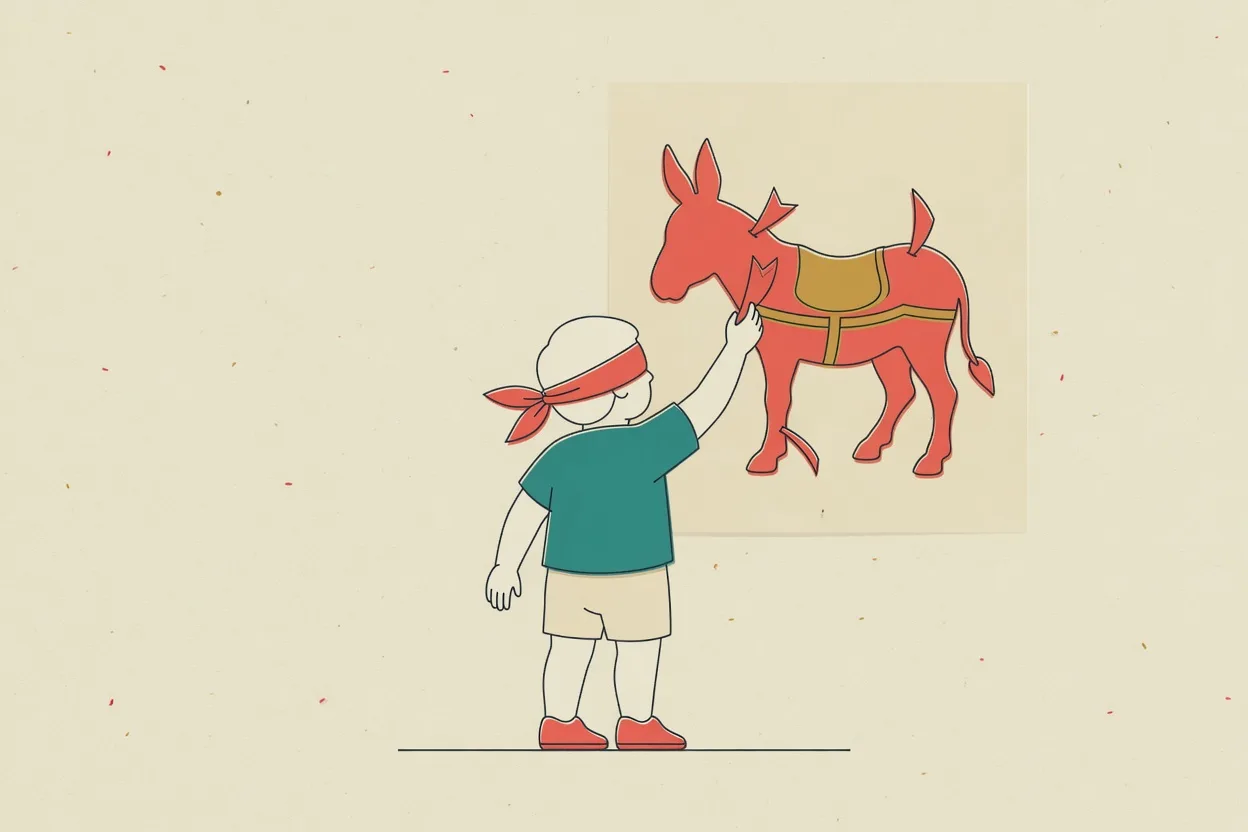
Pin the tail on the donkey barely needs explaining — everyone has played a version of it, even if it's been years since the last one. A poster of a tailless donkey, a paper tail with a loop of tape on the back, a blindfold, and a line of children taking turns to walk forward and guess. It is cheap, it needs almost no space, and a four-year-old and an eight-year-old can play the same round without either of them being bored.
The whole game lives or dies on three small decisions: how hard you spin a child before they set off, what you stick the poster to the wall with, and how you keep the line from crowding in behind whoever is currently blindfolded. Get those right and it runs itself for twenty minutes.
How many spins, and how far away
Spin counts should scale down with age, not stay fixed. For three- and four-year-olds, one gentle turn in place is plenty — any more and a small child loses their footing rather than their sense of direction, which is not the same game. Five- to seven-year-olds can usually manage two to three spins. From about eight up, three to four spins genuinely disorients them in the way that makes the game funny rather than just difficult. Stand the child roughly six feet from the poster before you spin them, and always spin gently by the shoulders rather than letting them spin themselves — a child-driven spin has no ceiling on speed.
Position the poster at the children's head height, not the adults', and tape it to a clear stretch of wall with nothing breakable on either side. A hallway or a garage door works better than a busy living room wall, because the six feet or so a spun child needs to wander in is more than people expect.
What goes wrong
The single most common mistake is pins. A blindfolded child pressing a sharp pin into a poster at head height, surrounded by other children standing close enough to watch, is a genuinely bad combination — someone's finger ends up in the wrong place at the wrong moment. Roll a loop of tape onto the back of each tail before the game starts, and nobody needs anything sharp at all. It sticks to a poster just as well and peels off just as easily for the next round.
The second failure is the line. Children who are waiting their turn drift closer and closer to whoever is currently blindfolded, partly to see better and partly because nobody told them where to stand. Mark a line on the floor with tape about six feet back and make it a rule before the first turn, not after the second collision. Keep an adult's hand near — not on — the blindfolded child at all times, not to steer them toward the poster, just to catch them if the spin has left them unsteady.
The same line problem shows up in piñata, which is worth reading if your lineup includes children young enough that turn order matters as much as the game itself.
What you need
- A donkey poster (store-bought) or a donkey drawn on a large sheet of paper
- One paper tail per child, with a loop of tape already rolled on the back
- A soft blindfold that actually blocks the light, not just a scarf
- Masking tape or sticky tack to hang the poster — never real pins
How to play pin the tail on the donkey
- Tape the donkey poster to a clear stretch of wall at the children's head height, with nothing breakable within about six feet on either side.
- Give each child a paper tail with a loop of tape already rolled onto the back — no pins.
- Mark a line on the floor about six feet back from the poster, and line the children up behind it.
- Blindfold the first child, check they genuinely cannot see under the edges, and turn them gently by the shoulders — one spin for kids under five, two to three for five- to seven-year-olds, three to four from eight up.
- Point them toward the poster and let them walk forward on their own to stick the tail wherever they judge the donkey to be.
- Mark or note where each tail lands, then move to the next child in line.
- Whoever pins closest to the correct spot — measured once everyone has had a turn — wins.
Variations
Pin the nose on the snowman or reindeer (seasonal swap)
Swap the poster art for whatever fits the party — a snowman missing its nose, a reindeer missing an antler, a pirate missing an eye patch. The mechanics don't change at all; only the picture and the paper piece do, which makes this the easiest theme swap in the whole games library.
Eyes closed instead of blindfolded (ages 3–4)
For children who find a blindfold itself upsetting, let them simply close their eyes and promise not to peek, with an adult standing close enough to check. It is easier to enforce than it sounds at this age, because three- and four-year-olds are usually more interested in the sticking than the guessing.
Team version
Split into two teams and let one member from each side go at a time, alternating turns. Add up how close each team's placements are to the target spot across all rounds — lowest combined distance wins. Good for a bigger party where a single-file line would take too long.
Frequently asked questions
- How far should you spin a child before pin the tail on the donkey?
- Scale it to age rather than using a fixed number: one gentle spin for three- and four-year-olds, two to three for five- to seven-year-olds, and three to four from about eight up. Always spin by the shoulders yourself rather than letting a child spin on their own, so you control the speed.
- Can you play pin the tail on the donkey without pins?
- Yes, and you should — roll a loop of tape onto the back of each paper tail instead. It sticks to a poster just as well, needs nothing sharp anywhere near a blindfolded child, and peels off cleanly if you want to reuse the poster.
- What age is pin the tail on the donkey suitable for?
- From about three, with the spin count adjusted down for the youngest players — a single gentle turn is enough for a three- or four-year-old. It stays fun up to about ten, because judging distance blind is genuinely tricky at any age.
- Do you need a real donkey poster, or can you draw your own?
- Either works. A store-bought poster is one less job on the list; a hand-drawn one on a large sheet of paper costs nothing and lets you match the party's theme. The game plays identically either way.
Perfect for these parties
Themes that build a whole party around this game — with the food, the decor and a printable invite to match.