
3–9
Ages
4–20
Players
Indoors
Where
10–20 min
How long
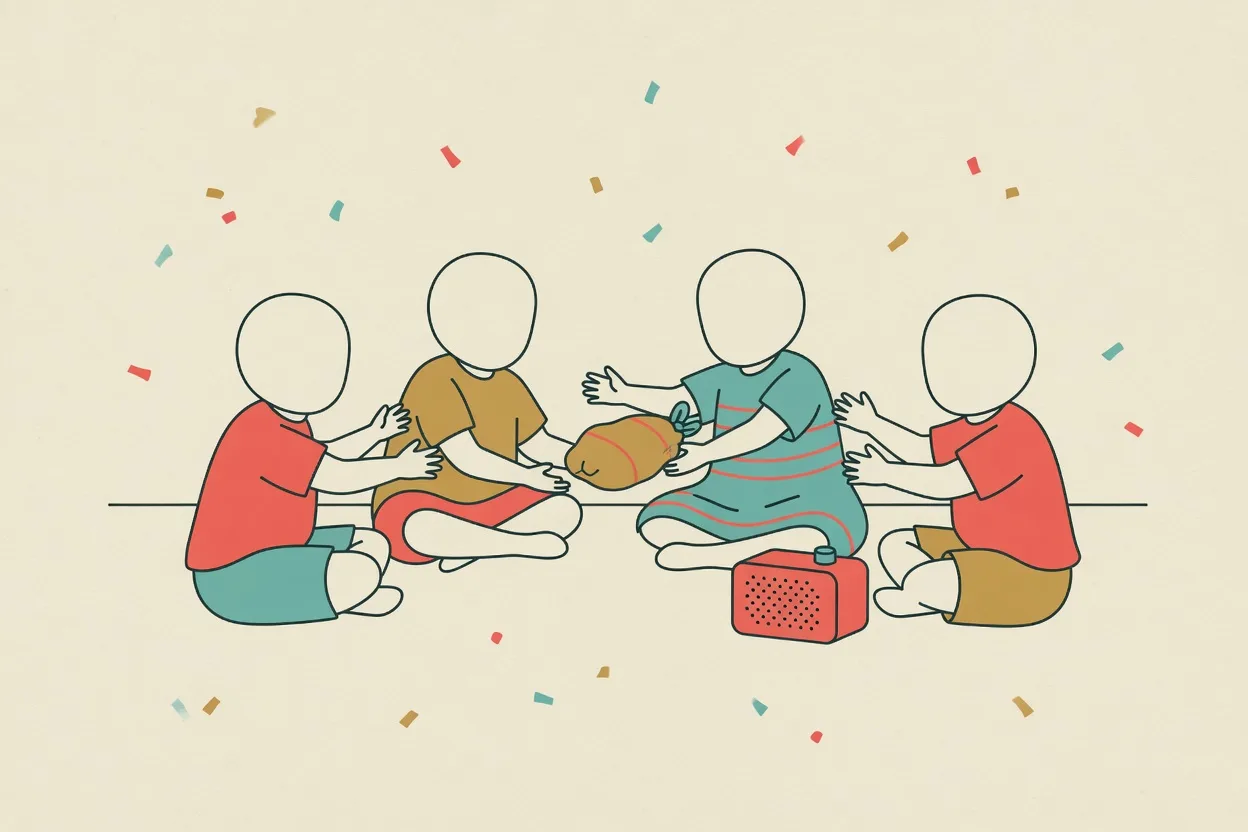
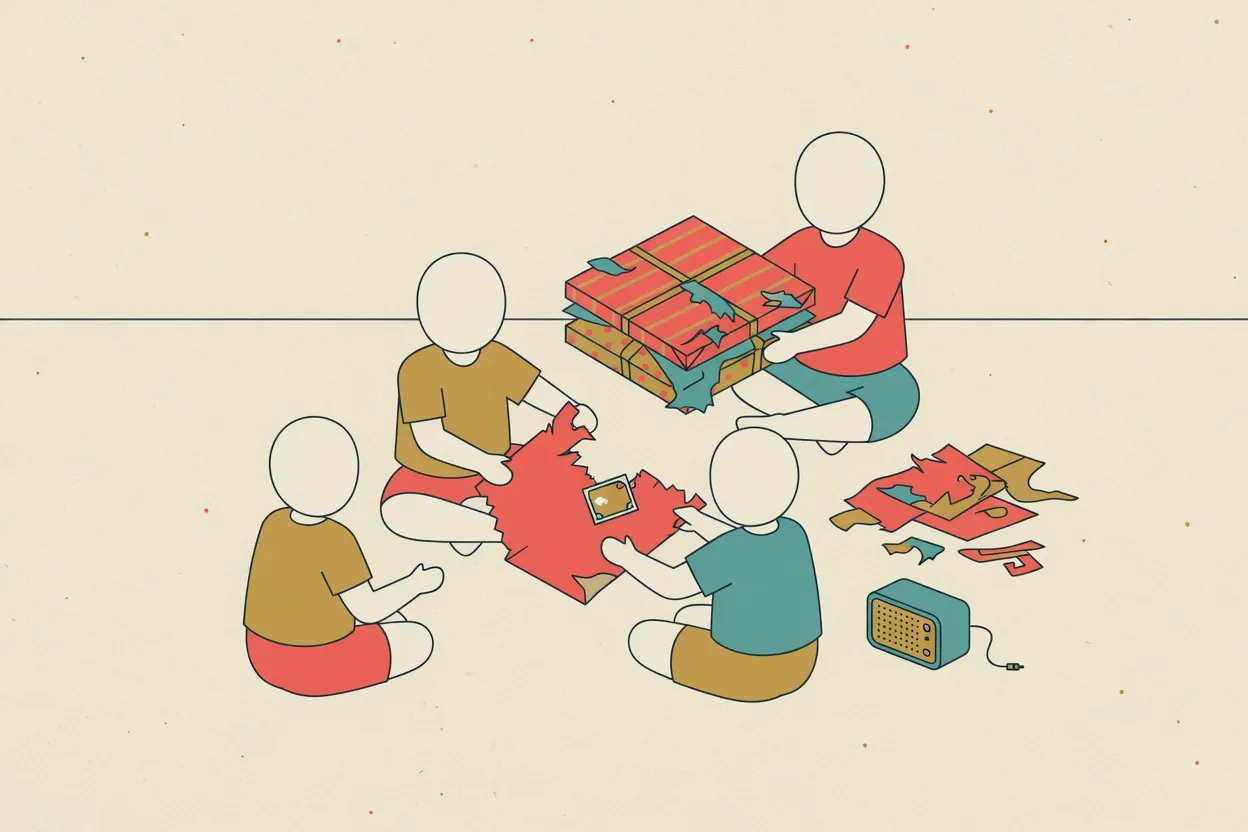
Pass the parcel — the slower, unwrapping cousin of hot potato — needs almost no setup and works in a room too small for anything else, which is why it has survived decades of birthday parties without anyone improving on it. A wrapped prize goes around a circle of seated children while the music plays; when it stops, whoever is holding it tears off one layer. Repeat until the paper runs out. The whole game lives or dies on two decisions you make before a single child arrives: how you wrap it, and what's inside.
Layer count matters more than most parents think. Wrap for the number of children playing, not for how long you want the game to last — twelve children need twelve layers, not twenty, or the last third of the group is still waiting for a turn while the first third has already unwrapped and wandered off. A roll of cheap paper and ten minutes the night before is the entire preparation.
Wrap from the inside out in whatever paper is cheapest — newspaper, the ends of an old roll, plain brown paper — and save your best-looking sheet for the outermost layer alone, since that's the only one anyone will actually see in photos before the unwrapping starts. Nobody remembers layer six; everyone remembers what the parcel looked like sitting in the middle of the circle.
Does every layer need a prize?
This is the argument every parent has with themselves at the wrapping table, and it's worth settling before the party rather than during it. Our answer: no. Put one real prize at the center, and tuck a small piece of candy or a sticker into roughly half the outer layers — enough that unwrapping never feels pointless, not so many that the center prize stops feeling special. A parcel with a treasure in every single layer teaches children that unwrapping is the whole point, which then makes the one child who lands on an empty layer feel genuinely short-changed. A parcel with nothing until the center makes ten children sit through nine disappointing tears before anyone is rewarded. The middle path is the one that actually plays well in the room.
Keeping the stopping fair
The music is doing a second job here that people forget: it decides who gets which layer, and children notice instantly if it looks rigged. Run it exactly like the stop-and-start in musical statues — the adult on the music shouldn't be able to see the circle, and the gaps between stops should vary so nobody can time their handling of the parcel to land a stop on themselves.
What goes wrong is almost always the same thing: a child who's quick with their fingers works out how to get two layers off before anyone notices, or a slower child gets skipped entirely because the parcel moves on before they've managed to peel their edge back. Watch for both. Slow the music's tempo for younger groups, and if a slow child is clearly still working on a stubborn bit of tape when the music stops again, let them finish that layer before the parcel moves on — the rule is one layer per stop, not one stop per turn.
If your circle is more interested in speed than suspense, hot potato swaps the slow unwrapping for a straight elimination pass and plays in half the time — the two pair naturally back to back at the same party, one slow and one quick.
What you need
- One prize, wrapped in a fresh layer of paper for every child playing
- Small candies or stickers to tuck into roughly half the outer layers
- Music and a speaker, plus someone to control it
- A roll of tape for wrapping ahead of time
How to play pass the parcel
- Wrap the prize, then wrap it again in a fresh sheet of paper, and keep going until you have one layer for every child playing — twelve children, twelve layers.
- Tuck a small candy or sticker into about half the outer layers, leaving the rest as plain paper so the surprise stays uneven.
- Sit everyone in a circle and hand the wrapped parcel to one child to start.
- Play music and have the parcel pass hand to hand around the circle in one direction.
- Stop the music without warning. Whoever is holding the parcel removes exactly one layer, then passes it on when the music restarts.
- Keep going until the last layer comes off — whoever unwraps the center keeps the prize.
Variations
No elimination, ages 3–5
Don't count layers per child and instead make sure everyone gets at least one turn holding the parcel, prize or no prize inside that layer. At this age the passing and the tearing is the fun; a strict one-child-per-layer rule just means somebody never gets a turn.
Pass and perform
Write a small dare on the inside of a few layers — a joke to tell, an animal to impersonate, ten jumping jacks. Works best from about six upwards, and it turns the layers without candy into their own kind of prize.
Two parcels at once
For a big group, run two smaller parcels in two circles rather than one enormous one. Nobody sits through fifteen other children's turns before their own, and it roughly halves the time the game takes.
Pass the parcel relay
For older children, split into two circles racing to finish first rather than one shared circle. Whichever team unwraps its center first wins, which adds a genuine contest for eight- to ten-year-olds who find the classic version too gentle.
Frequently asked questions
- How do you play pass the parcel?
- Children sit in a circle and pass a prize wrapped in many layers of paper while music plays; when the music stops, whoever is holding the parcel removes one layer. The music restarts and the parcel moves on, and whoever unwraps the final layer keeps the prize at the center.
- How many layers should pass the parcel have?
- One layer for every child playing, so everyone gets exactly one turn — twelve children need twelve layers, not more. Wrapping extra layers just to stretch the game out means the group at the back is waiting through turns that have nothing to do with them. Wrap in cheap paper and save your best-looking sheet for the outside.
- Does every layer of pass the parcel need a prize?
- No — put your one real prize at the center and tuck small candies or stickers into roughly half the outer layers. A treat in every single layer makes the center prize feel unremarkable, and a parcel with nothing until the middle makes most children unwrap an empty layer.
- What age is pass the parcel good for?
- From about three up. Kids under five do best with a relaxed version where getting a turn matters more than what's inside the layer; from about six, children start caring who gets the center prize, and the classic version works right through to ten or eleven.
- How do you stop the same child from always getting a good layer?
- Vary the length of each burst of music so nobody can time a stop, and control it from somewhere you can't see who's holding the parcel. Standing behind the circle works. A visibly rigged stop is the fastest way to end the game in an argument, and children notice instantly if it looks rigged.
Perfect for these parties
Themes that build a whole party around this game — with the food, the decor and a printable invite to match.