
4–12
Ages
1+
Players
Indoors or out
Where
15–30 min
How long
A scavenger hunt is a checklist, not a trail — everyone gets the same list of things to find, and they go and find them in whatever order they like, at the same time as everyone else. That's the whole difference from a treasure hunt, and it's the reason a scavenger hunt suits a bigger, more spread-out group: there's no single sequence to bottleneck behind, so ten children can all be searching for different things on the same list at once.
What follows is three ready checklists — nature, backyard and indoor — the age each suits, and the one rule that stops it turning into ten children running full speed into each other.
Three checklists, ready to use
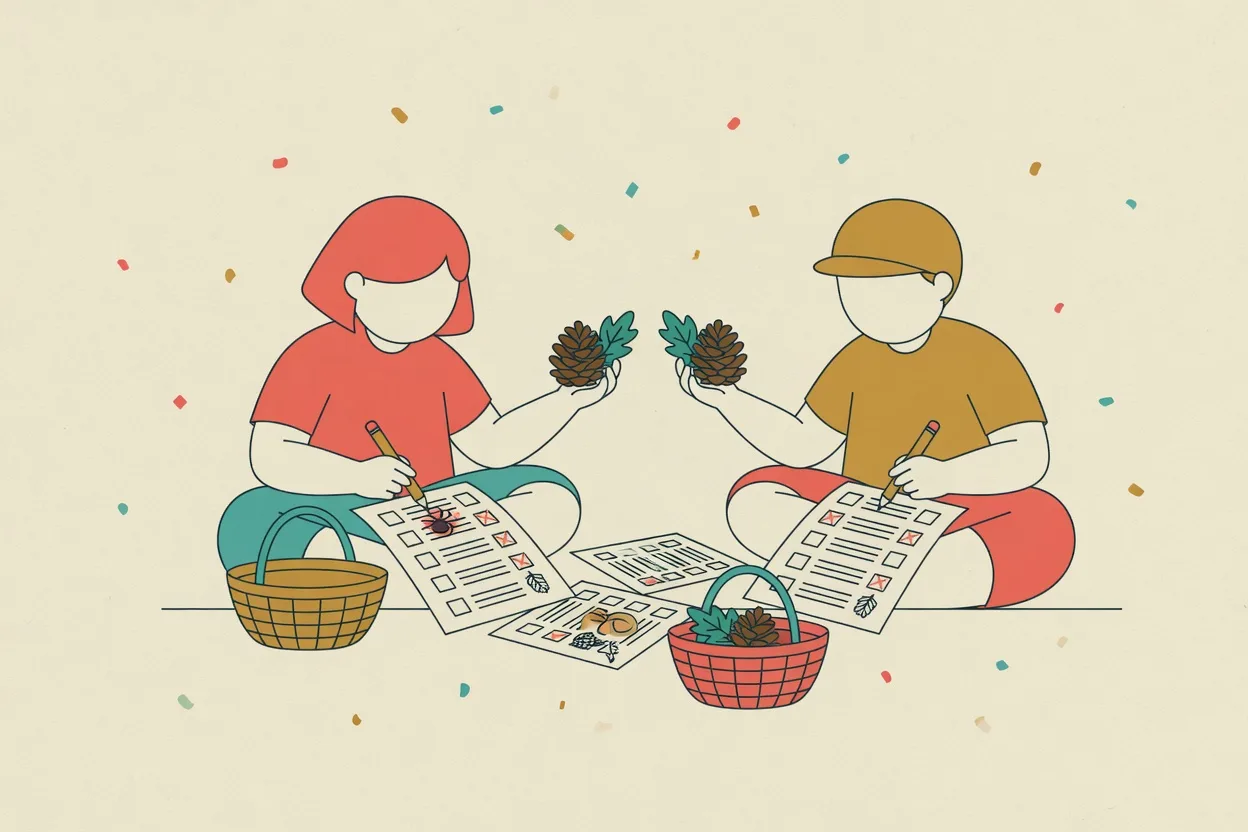
A nature list works anywhere with a bit of green — a smooth stone, a leaf with more than five points, something yellow, a feather, a snail shell, something that smells nice. A backyard list leans into whatever's actually in the space — a pine cone, a dandelion puff, an ant, a spider's web, something prickly, three different-shaped leaves. An indoor list works as a wet-weather backup or for an apartment with no outside space — something that makes a sound, something soft, something with your name's first letter on it, a spoon, something red, a book with an animal on the cover.
Keep the list to eight or ten items for kids under seven and up to fifteen for older children, and mix easy finds with a couple of genuinely tricky ones — an all-easy list gets solved in ninety seconds and an all-hard one stalls the youngest players completely.
Why it's different from a treasure hunt — and what goes wrong
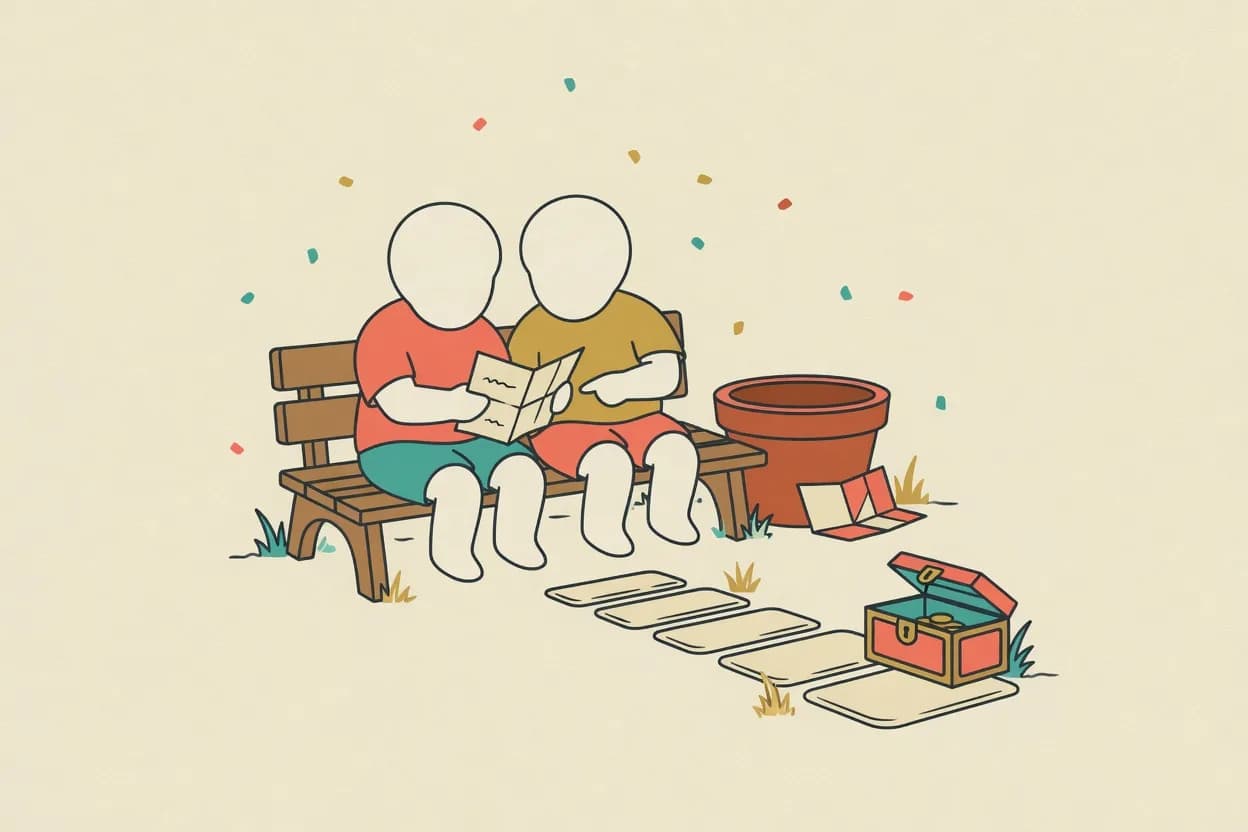
The two get confused constantly, and the confusion is fair, because both involve children searching for things at a party. A treasure hunt is sequential: clue one leads to clue two leads to the treasure, in order, as one trail. A scavenger hunt is parallel: everyone hunts the same list at the same time, in any order, and there's no single path to follow. That makes a scavenger hunt the better choice for a bigger group or a space with real room to spread out, and a treasure hunt the better choice for a small group you want to keep together.
The thing that actually goes wrong is speed, not the list itself — a scavenger hunt with no time limit either finishes in three minutes with everyone bored, or drags on for twenty with the slowest child still hunting alone after everyone else has stopped. Set a clear time limit before you start, ten minutes is usually right, and call time whether or not every list is complete. Judge on the fullest list within the limit rather than requiring every single item, so a nearly-complete list still has something to show for it.
The two hunts pair well at the same party — a treasure hunt to open with everyone together, then a scavenger hunt once the group is confident enough to spread out and search on their own.
What you need
- A printed checklist per child or team, five to fifteen items long
- A pencil for checking items off
- A small bag or basket to collect anything that can actually be carried
- A small prize for finishing, or for the fullest list
How to play scavenger hunt
- Print or write a checklist of eight to fifteen items, matched to the space you're playing in — nature, backyard or indoor.
- Give each child or team a copy of the list and a pencil, and set a clear time limit — ten minutes is usually right.
- Let everyone search at the same time, in any order, checking off or collecting each item as they find it.
- Call time when the limit is up, even if lists aren't finished.
- Compare lists and reward the fullest one — or, for younger groups, treat every child who found something as a winner.
Variations
Photo scavenger hunt (ages 8+)
Swap physical collection for a photo on a shared phone or camera of each item found in place, rather than carrying it back. Good for items you don't want picked (flowers, insects) and for older children who enjoy the phone itself being part of the game.
Team scavenger hunt
Split into pairs or small teams rather than sending children out solo — it suits younger players who don't want to search alone, and it halves the number of lists you need to prepare.
Color hunt (ages 3–5)
Simplify the whole list to five colors instead of named objects — find something red, something yellow, something green — which younger children can play without reading at all.
Frequently asked questions
- What should be on a scavenger hunt list for kids?
- Mix easy and tricky finds so the list holds interest at every age on the team — a nature list might pair an easy 'a leaf' with a harder 'something with five points'. Eight to ten items suits kids under seven; up to fifteen works for older children.
- What is the difference between a scavenger hunt and a treasure hunt?
- A scavenger hunt is a checklist everyone searches at the same time, in any order. A treasure hunt is a sequence of clues followed one at a time, each leading to the next, ending at a prize.
- How long should a scavenger hunt last?
- About ten minutes for most lists. Set the limit before you start and call time when it's up regardless of how complete the lists are — an open-ended hunt either finishes too fast or drags on long after the youngest children have lost interest.
- Can you run a scavenger hunt indoors?
- Yes — swap outdoor items (a leaf, a stone) for indoor ones (something soft, something that makes a sound, a spoon) and it works exactly the same way. It's the easiest wet-weather backup for an outdoor party.
Perfect for these parties
Themes that build a whole party around this game — with the food, the decor and a printable invite to match.